

Summary
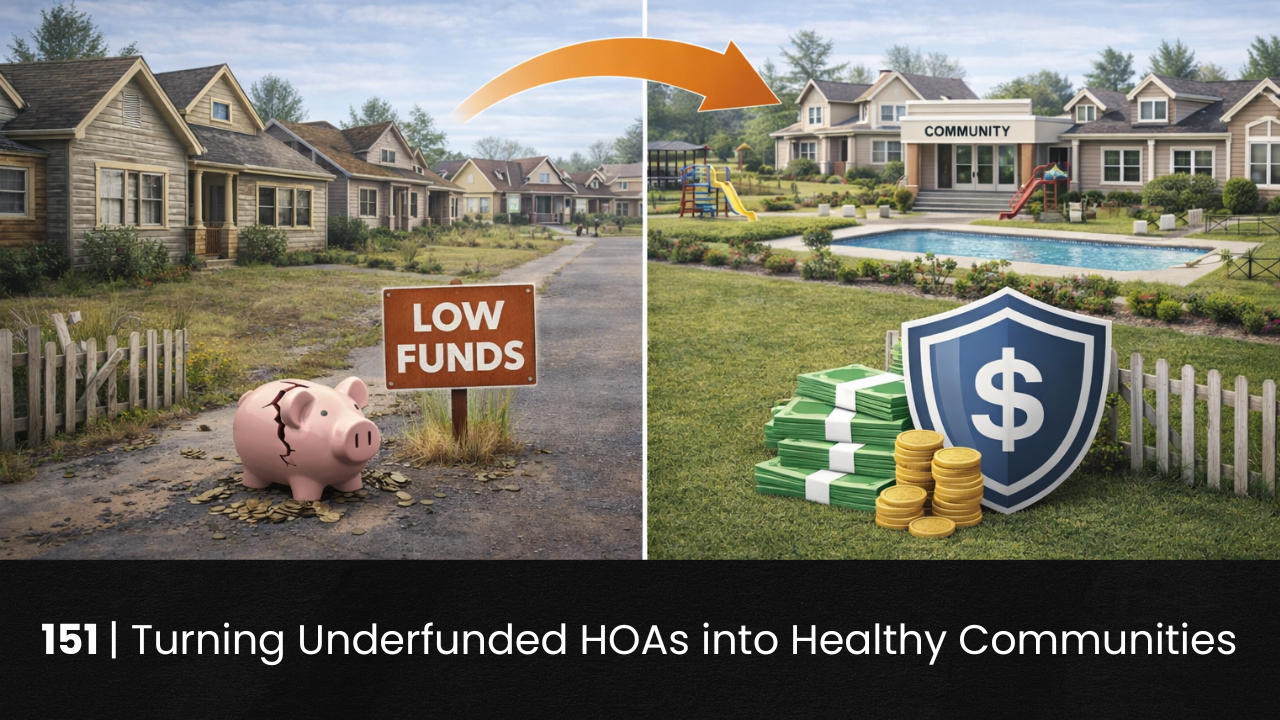
Most underfunded HOAs stay stuck. This HOA Board Heroes story shows you how to break the cycle!
Transcript
151 | HOA Board Heroes: Turning Underfunded HOAs into Healthy Communities
Hal Hovey 00:00
The thing I really like about the CAI members, the business partners, is they understand Hoa, so I’m not hiring a contractor who doesn’t understand why it takes us three months to make a decision, you know, in five months to get to get paid sometimes. And you know why they can’t just come up to the board president and say, Hey, I need to do this. And have me say, Yeah, okay, go for it. I got to go run it through the board.
Announcer 00:28
A regular highlight of the HOA Insights podcast is our board heroes feature, where we dedicate one episode each month to celebrate the remarkable efforts of HOA board members. To us a board hero is one of the 2 million elected volunteers who deserve recognition for excelling in a role that often goes unnoticed. Today, we’re excited to spotlight one of these exceptional board heroes and share their inspiring story. If you match our definition of a board hero, or know someone who does, please reach out to us. Our contact details and those of our sponsors are provided in the show notes.
Robert Nordlund 00:58
Welcome back to Hoa Insights: Common Sense for Common Areas. I’m Robert Nordlund, and I’m here today for episode number 151, with another one of the board heroes. We’re proud to celebrate. I read a column from this board member, Hal Hovey, in the July, August issue of CAI’s Common Ground magazine. I liked it. Was able to get in touch with them, and we’re fortunate to have him on the program today. His column in common ground was titled the power of community leadership. But in chatting with Hal before this episode, I found he has so much more to share about what a caring, curious and courageous board member can do for their association. So today we have with us Hal HOA V who started his community association involvement with the purchase of a home in a self managed waterfront community, and then finding the way the association was not up to his expectations. Fancy that, he started getting involved with the Association, and frankly, they just weren’t keeping the place well maintained. So he’s now served in multiple roles across three different associations. Six years ago, was elected to serve on the board of the CAI Washington State chapter, one of the largest CAI chapters in the country, and is currently on the CAI national homeowner Leaders Council. But before we get to hal’s story, I hope you enjoyed last week’s episode number 150 if you missed that episode or any other prior episode, you can find them on our podcast website, Hoa insights.org, on your favorite podcast platform, you can search HOA insights and find it on YouTube, but better yet, subscribe to the podcast or our YouTube channel in order to get every episode delivered right to your phone or mobile device. Now, about half of our audience stumbles onto this podcast based on a search subscribing not only gives you regular reminders when we drop a new weekly episode and the topic of that episode, more subscribers increases our ranking in podcast search engines, and that helps us encourage and equip more and more board members at associations all across the country, and that’s what we’re trying to accomplish. Well, those of you watching on YouTube can see the mug that I have here, my HOA insights mug with deferred maintenance at a condominium association, and I got that from our merch store, which you can browse through from our Hoa insights.org website, or it’ll be in today’s show notes, and you’ll find we have plenty of free items there, like board member zoom backgrounds, some specialty items for sale, like the mug. And so take a moment after the show see what we have for you in the merch store and at least pick up one of our free items before your next board meeting. Well, we enjoy hearing from you, and most episodes are in response to a topic you’ve recommended. So stay in contact, letting us know what questions you have or topics that you’d like to hear more about. Leave us a voicemail at 805-203-3130, 052033130, leave a comment in the YouTube video or send us an email at podcast at Hoa insights.org, but back to today’s episode. So how did you ever think that some maintenance concerns of that first condominium association would take you down this path?
Hal Hovey 04:20
No, I had absolutely no idea. I don’t think I even knew what I was getting into. You know, I owned properties, and Hoa is for 25 years, never really got involved in them, you know, just kind of sit back and you pay your monthly bill and assume that everything’s running well, that I was in for shock, because all the previous Hoa is I lived in, it were all professionally managed, and they did run really well. But this one was private. It was, you know, self managed, and it was quite a different experience.
Robert Nordlund 04:46
So what was it actually? Was it like a sidewalk that was uneven? Was it some cracks in the asphalt? What was that trigger that got this all going
Hal Hovey 04:55
for you? You know, it was mainly just. Uh, going to some of the initial meetings and seeing that. They didn’t really have a plan for doing things. They didn’t really know how much money they were making or how much money they were needing. The maintenance was obviously deferred already when we bought we knew that, but we didn’t really understand the extent of it. You know, you can kind of get a clue when you’re looking at a property and it’s only painted as high as the ladder goes. But when you got four story buildings, that doesn’t cut it over the long term,
Robert Nordlund 05:30
you got three stories above a ladder height.
Hal Hovey 05:33
So anyway, going to a couple meetings, and, you know, at one point, the question came up about, you know, are we covering our bills? Or do we have enough money to pay for something? And the treasurer, who had been treasurer for quite some time, spoke up and said, Yeah, well, I think so. And then the vice president, who was a little bit smarter on this stuff, said, Well, no, we’ve been taking money out of savings for, you know, two years. And that was kind of my first real clue that their finances were kind of shabby.
Robert Nordlund 06:02
Had you been to board meetings at your prior associations? Was there a need for you to go to board meetings at your prior associations?
Hal Hovey 06:08
I never went to one. I didn’t probably even know when they were, you know, it was like I said. It was just you pay the bill, and everything seems to be running pretty well. The extent of my involvement with previous associations was one I lived in where I got a notice of warning that had to remove my satellite dish. Well, I didn’t have a satellite dish. It was the neighbors across the street. You know, this is a bit back in the days when they were big, eight foot wide ones. So it’s pretty clear who had one who didn’t. Yeah.
Robert Nordlund 06:39
Okay, so significant things like that, but obvious changes. I remember when I was president to my association. We ranked the people I can. I think I can, yeah, I can say it’s, it’s our podcast. We can say what we want. We ranked them on a five point scale. The top was the involved owners, the people who are helping carry the association forward. Number two was the involved, helpful renters who were nice. They reminded us that the laundry machine number two was broken, or something like that. Number three was the not involved owners, but they always paid their bills now that you may have been number three, where you just the silent majority, just helping the association run. Number four was the annoying renters, and number five was the annoying owners, the annoying renters we knew they would leave someday, the annoying owners were just, we didn’t know how long, ago, yeah, just, just annoying, well said. And so there’s different types of people that you have in the association. How much of a factor at that association was that it was self managed? Was that what left them kind of drifting?
Hal Hovey 07:54
Yes, I think that was probably 90% of it is that, you know the treasurer didn’t have the proper training to do good treasure stuff? This is a kind of condo buildings, and they were, at that point, to 20 some years old, and they just hadn’t been raising the dues and, you know? And one of the things that I’ve learned, I’m a real estate agent now, he used to be the military, but one of the things I’ve learned in the real estate business is that a lot out of the newer condominium complexes in particular will have very low monthly dues because they’re not really putting anything into the reserve fund. And then, you know, 10 years down the line, they realize, oh, wow, we’re already behind,
Robert Nordlund 08:35
way behind. 10 years behind, yeah, yeah, okay, well, that’s sounds like a an issue of training. So is that something that you see as a now that you have kind of a national perspective before you had maybe a statewide perspective, but is that common that you see across the country that there’s a lack of training what a board member needs to know to do their job.
Hal Hovey 09:01
Well, I think it’s even more fundamental than that. You know, there’s certainly availability of training for people who know that they need it. The problem is that there’s a lot of homeowners, homeowner board members, who don’t realize that they need some training. You know, you don’t know what. You don’t know type of thing. That’s exactly what I was thinking. Yeah. And so if you have a board member who’s in a critical position, like a president or a treasurer, you know, sometimes you can get just so far behind the power curve that you don’t realize it. You know, we had, I think the first year I was on the board, maybe it was the second year. By then, we had a professional CPA from Boeing who was our treasurer, had taken over his treasurer. We finished up the year with $89 in the bank. And this is on, you know, condominium association with, you know, $250,000 going through our accounts per year. And we finished with $89 and that’s operating account. We didn’t have a survey account at that point. Gee, that’s the.
Robert Nordlund 09:59
And what’s a good rule of thumb, three months of operating expenses?
Hal Hovey 10:04
Yeah, I would say at least. And you know, you’re in the reserve business. You know better than I would wish to have for reserves, but in a 20 something year old Association, you need to have at least something. You know you’re 10 years away from replacing roofs,
Robert Nordlund 10:19
yeah, and you’ve got 10 years of deterioration that you just can’t get back because the deterioration on the roof and the asphalt and the paint and everything has kept on going. It’s like a race car that is spending the first half of the race in pit row. You’re just way far behind. Okay, what can we do to outside of someone stumbling onto this podcast. How would a board member learn that? Oh, gee, I need to find out what I’m supposed to be doing here. How do we trigger that?
Hal Hovey 10:53
Well, it’s interesting because our association, this one I bought into, joined the Washington State Chapter of the community Associations Institute. And the reason we joined was because our Boeing CPA treasurer was in another Association down in Seattle, and he his association was a member of WCAI. So it was through that that I became aware of the trainings that were available because, you know, up here in Washington state, they send out monthly magazines, and they have the trainings in there and all that kind of stuff. And you can get an email list. And there was a training that I wanted to go to, and so I went to it, and, wow, I just, you know, I never looked back. I realized that there’s just so many resources out there that you just need to be made aware of them. And as a member of CAI, both nationally and you know, our local chapter, they’re really good about making people aware of what’s available.
Robert Nordlund 11:52
Yeah, and I could only imagine that to someone who just wasn’t sure about what they’re getting into to finally get exposed to a group of people who had resources, had training, had doesn’t see AI, have their they call them the gap reports guide for Association practitioners, how to be a president, how to be a treasurer, how to be all this kind of stuff. So they have written resources and monthly meetings. Many chapters have monthly meetings where they have guest speakers, and some often trade show around the back, where you’ll find a roofer or a painter or a CPA or things like that, professional services, a management company, or two or three. Maybe we should say it for anyone who’s not familiar with CAI, their website is Cai online.org, Cai online.org, and there you can find out a list of local chapters across the country. You can become a member. You can get, like Hal said, part of their electronic things, they have a national magazine every other month, the common ground magazine. And I kind of want to say you don’t have to reinvent the wheel. People been doing this all across the country for decades, and CAI is there to help. But outside of CAI, what other things? What other resources did you find through CAI?
Hal Hovey 13:11
I realized that there’s a lot of expertise that’s available from the business partners, that’s free. So for example, I know that there’s a number of reserve companies who have online webinars that specialize in reserve studies. There’s some attorneys that we have locally that have a weekly webinar where you can call in with your questions, and they don’t give you specific legal advice, but they give you, you know, generic legal advice. There’s a local structural engineer who has, you know, weekly training. You know, we have all kinds of resources that you don’t have to pay for, and it’s all from the experts. You know, that’s one of the problems that we had as a self managed Hoa is like, Well, we had a guy who worked at Home Depot, and was familiar with a lot of contractors. So when we had contracting or engineering questions, we’d go to him, you know, we had the CPA, who’s who knows accounting, but he doesn’t necessarily know HOA accounting, because it’s such a different animal, you know? And we had, initially, we had a treasurer who worked in school district, and she knew math, so that’s how she got to be the treasurer. But when you, when you reach out and you find out that there’s experts who will give you advice for free, in most cases, you know, it’s just, it’s, I mean, it’s an insight into a whole new world.
Robert Nordlund 14:35
Oh, yeah. And for an association that had less than $100 at year end, you are indeed trying to be very careful about your money. Well, it seems like a light bulb came off or went came off, went on, went turned on. Was it a similar experience for the other board members that you served with?
Hal Hovey 14:51
You know, for some of them, I think so, certainly getting the professional, you know, CPA, as a treasurer, i. Who was already a chapter member, that was a huge, huge step forward, because he kind of was our guide into a lot of this, other aspects of, you know, professionalizing how we operated, right? And then I was, you know, by the time I got on the board of the State chapter, you know, we were able to get our association professional management, but it was a long, hard fight to get the other board members to agree to find that hire a professional manager.
Robert Nordlund 15:31
That’s an important point. It takes momentum and it takes political capital, and those things take time,
Hal Hovey 15:38
and in some cases, it takes having a $200,000 you know, deferred maintenance project that you realize you’re in an over your heads on and you really needed somebody professional to help you through it.
Robert Nordlund 15:52
Yeah, sometimes it’s an emergency that becomes a unifying rallying cry saying, Oh, gee, we have a problem, and that can unify the board, that can unify the homeowners, and say, this is a problem. It’s a big problem. And what do you say? We don’t do this again? And you start saying, okay, maybe we should get management, maybe we should set more funds aside in reserves. Maybe we should get regular monthly financial reports. You’re talking about those kinds of things.
Hal Hovey 16:23
Yeah, and not only that, but also hiring the right contractors. You know, one of the things that I’ve learned is that up here in Washington State, we have two big convention type things each year, and they have the big trade show. So we have like, 150 business partners who are in the trade show, and I can’t tell you the number of professionals that I’ve hired through meeting them face to face. And the thing I really like about the CI members, the business partners, is they understand Hoa, so I’m not hiring a contractor who doesn’t understand why it takes us three months to make a decision, you know, in five months to get to get paid, sometimes. And you know why they can’t just come up to the board president and say, Hey, I need to do this and have me say, Yeah, okay, go for it. I got to go run it through the board. There you go. All this. AI business partners all understand how Hoa is work. That’s why they’re there. So you have overcome one of the stumbling blocks right off the bat,
Robert Nordlund 17:28
yeah, and they’re properly insured, so they can do work on community associations, and they’ve done it a time before, 10 times before, 100 times before, 1000 times before, depending on different cases. But okay, so it was an evolution at your association. Are you talking about a couple years? You’re talking about five years. How long do things take to kind of professionalize the way your board ran that association? We got
Hal Hovey 17:55
more professional pretty quickly because of I came on as the secretary. We had the owing guy came on as the treasurer, the construction guy took over as the president, and we all came on because we were concerned with the direction that the HOA was going to begin with. And we had all bought in there, all in the same year, which, you know, is kind of coincidental, I guess so, we all were trying to get in that professionalizing direction. But the actual getting professional management on board, it took a good 10 years.
Robert Nordlund 18:28
I want you to say that again. How many years? 10 years? Yeah, it takes time, and sometimes I think changing momentum at a community association is like turning a super tanker out in the ocean. It takes a long time, because the association has been doing it one way leadership that is fundamentally a committee, and you want to take the homeowners along with you. And so it takes time to make or build that political capital to say, this is a direction we are now going to go. And I think a bottom line of a lot of what this is, is is it’s going to cost more money to do this the right way, and a lot of that the right way is expensive. But then again, you have to make it clear that what we were doing wasn’t good. Isn’t that kind of the first argument of time to make a change, because you keep doing the same thing, you can’t be expecting different results
Hal Hovey 19:19
something like that, right? Yeah, definition of insanity, right?
Robert Nordlund 19:23
There we go. That’s it. That’s it. Well, Hal, this is fantastic stuff. I look at the time and I see it’s time to take a quick break, hear from one of our generous sponsors, after which we’ll be back to hear more from Hal, and we’ll talk about more about tension and some of the solutions that he was able to come across for his association,
Paige Daniels 19:43
numbers matter, and we need numbers like game scores and bank balances to let us know where we stand. The same is true for your association is yours, thriving or struggling. Let me introduce you to the FiPhO Health Score, like your own personal FICO credit score. Now in one simple number, owners and boards can learn. The combined financial, physical and operational health of their association. The good news, it’s free at ourFiPhO.com that’s our F, I, P, H, O.com, learn how your association measures up.
Robert Nordlund 20:12
And we’re back. Well, I’m enjoying a great time here with Hal Hovey, and we’re talking during our quick break about the tensions that he continues to see in the industry, and one of those is the tension that we see with scarcity. He got involved at his initial Association when money was scarce. So how do you see that as a common problem across the country, where associations are trying so hard to keep expenses low, that they’re actually kind of strangling their association. Yeah, I
Hal Hovey 20:45
think that that’s absolutely it. I think that’s part of the reason why people are elected to have professional management. Some cases, they think it’s too expensive, when in fact, it will save the money over the long term, because they’re actually, you know, hiring experts and trying to stumble through things and making mistakes. But certainly, you know, cost of materials for doing any kind of repairs have gone up. You know, a roof cost twice as much as it did five years ago. And a lot of times we just haven’t been keeping up on our estimates. But yeah, absolutely, I think that that’s a huge problem nationwide.
Robert Nordlund 21:16
Yeah, I see that tension. I hear about that tension. We obviously recommend reserve funding appropriate for those higher expenses. And we get a lot of treasurers, a lot of boards, a lot of managers saying that, gee, that can’t be right. We say, sorry, it is right. Everything’s expensive nowadays. And I think you in our viewing audience need to appreciate that. You think it’s expensive and it’s expensive everywhere.
Hal Hovey 21:42
And they, you know, they see the national headline is that, you know, inflation is 4% Well, that’s great, but our city utilities went up by 200% because we got a new sewer plant. And, you know, it’s not across the board that everything’s, you know, three or 4% inflation. Building Products have gone up 25 to 50%
Robert Nordlund 22:04
Yeah, I wish a lot of things were three or 4% there’s just a big expenses that we learned new words like supply chain problems, just a lot of new things in the last few years. And so it is expensive to run an association. Are there other areas where it’s becoming just plain hard to be a board member?
Hal Hovey 22:25
Well, there’s the perennial problems of having homeowners who make life more difficult than it needs to be. Is that the type fives? Yeah, exactly. You know, the there’s increased regulations in Washington State. We are in the process of going through completely revising how homeowners and community associations are managed. You know, from legislative standpoint, and you know that is causing a lot of stress. A lot of homeowners associations are saying, well, we don’t need to do this. Well, the state government has said, Yes, you do need to do this. You know, transparency is something that homeowners are increasingly wanting because, you know, they can go on the internet and find out almost anything instantaneously, but I can’t find out, you know, what’s the status of my Hoa is, you know, bank account. Why can’t I find that out? Why won’t? Why won’t, you know, you give me a website that I can go to to figure this stuff out,
Robert Nordlund 23:20
yeah, why? What are they doing with all my money, and why did it go up 10% when inflation is only 4%
Hal Hovey 23:26
Yeah, you know, I actually, as a board president, was accused of buying my new car through HOA funds. Of course. Yeah, I’m like, what my $89 in the bank? You know, I bought
Robert Nordlund 23:41
my new Toyota with that. Yeah, there you go. Wasn’t it a Seinfeld episode? Do you remember that from long ago where Jerry, yeah, Jerry gave went down to Florida, and he was doing great as a comedian, and he bought his dad a Cadillac. His dad was the president of his association down in Florida, and so he started driving. The dad started driving around this big Cadillac, and everyone thought he was skimming Association funds. And it was just his son bought him a Cadillac. Yeah, if you want to get wealthy, don’t try to skim a little bit off of community association funds, because those are budgets that have been scrutinized for years and years and years. And there’s new boards that say, Well, I’m going to cut the fat. Well, I think the fat was cut, what, 10 or 20
Hal Hovey 24:29
years ago. I don’t think there was ever any fat in anybody’s budget. I mean, you know, honestly, people are such spectros that they won’t, they won’t. You know, we had $180,000 project. We actually came in under cost, good. And because we came in under cost, a bunch of homeowners insisted that we give them a refund on their special assessment. And being $180 to each of the homeowners, it’s like, why can’t we just leave that in the reserve account?
Robert Nordlund 24:58
Yeah, because we’re gonna have to. Paint. We’re going to have to do this, we have to do that, we have to do something else, and we’re all homeowners here. Yeah, there’s different ways to look at it, but there’s a tent. Well, do you have any well, going back to what you spoke about earlier, the developer often sets up an association with a little bit lean budgets, and so there often never was any fat to start with. If anyone was deficit a budget, not enough funds to run the association. But how do you encourage our board member audience to deal with the stress of working with the homeowners, trying to get on the same page with them? Well, the key to
Hal Hovey 25:39
everything is always communication, isn’t it? You know, as long as you keep communicating with people, give them regular updates, send out the minutes in a timely manner, have them minutes say what actually happened in the meeting. You know, have a budget that’s clear. Instead of just saying, We made this much this month and we spent this much this month, you know, itemize it. Tell them that, oh, we had an unexpected expense of $4,000 for the elevator or whatever the case is. But you know, transparency and communication get you a long, long way with the homeowners.
Robert Nordlund 26:13
I agree, and that builds that trust and political capital. I’m down here in Los Angeles, and when there’s construction on the freeway, it’s always a hassle, and it seems like it’s always happening at just the wrong time when I’m trying to get somewhere. But I like going by the big orange signs that say your tax dollars at work, and I at least know that, okay, I pay a lot of money in taxes. But now the freeway is going to have five lanes instead of four, and traffic is going to flow smoother. So like you say, communicating, being transparent, this is what your money is doing. We’re making improvements. If there’s problems with X or Y or Z, you can say, this is what we’re doing to address that. I really like that, and that is that what you’re doing to build the community of we, rather than us and them, board members and homeowners,
Hal Hovey 27:03
yeah, and, you know, starting people off with the right foot of you know, welcome to our community. This is what it’s like to live in an association. You know, a lot of people are who are coming here are retirees. They’ve never lived in a condominium association before. I’m speaking to my previous Association. Actually, you know, they don’t understand that, yeah, you live on the first floor, but you still have to pay for the elevator for everybody else. And, you know, that’s, you know, we’re a communist organization where everybody’s in it
Robert Nordlund 27:32
together, and you’re on the first floor, you’re paying
Hal Hovey 27:34
for the roof, yeah, and everybody’s in it together. Are you still
Robert Nordlund 27:38
on the board at your association, are you moved to a new, new place?
Hal Hovey 27:43
Yeah, I’m in another community right now. We sold our condominium and we bought a single family house on acreage, and so there’s 35 houses in our current community. And I was on the board. I actually joined the board my first year, I got elected as a vice president, and our president resigned within four months, so I became the president, and did that for a couple years, and then I’m taking a little sabbatical from the board right now, but I’ll probably be back on in January, I would imagine.
Robert Nordlund 28:15
Okay, good for you. Well, you’ve got plenty of responsibilities with the CAI national homeowner, leader council that you took on. What’s your why did you say yes to that? And what do you hope to accomplish with your time on that important committee?
Hal Hovey 28:32
Yeah, well, I was, I was terming off of the state chapter board, and I just wanted to keep my fingers in what was happening, and maybe I had something to offer, and maybe I felt like the National chat and, you know, the national organization had more to offer to the state chapters that wasn’t really trickling down, and so I just wanted to get in there and do my part to speak up. And it’s been a really kind of eye opening. Yeah, what’s that? How? So? How so? Well, national, you know, it’s a big organization, so they move a little bit more slowly than the state board did, but they have their hands in so many different things at once that you don’t see as a lonely guy down. You know, at the state, you know, they’re deeply involved in legislation, legislation, they’re deeply involved in training. And eventually it all trickles out, and we may not even realize where it came from. So a lot of cases, like the corporate Transparency Act that we were talking about previously, you know, ci was fundamentally involved in that and transformed how that all came about. I don’t think down at the individual homeowner level or the individual board member level, we have any appreciation for why that got deferred. The Ci was intimately. Involved in making sure that that happened?
Robert Nordlund 30:01
Yeah, they fought hard to if anyone’s not sure what we’re talking about, it was a couple years ago that board members all across the country were going to have to register because of a was it banking, or was it security, something like that concerns, and it was just, if you’re going to be a part owner in a bank, that’s one thing you you have security issue concerns, but for being the treasurer of ABC Hoa, there was a lot of pushback having to register with the government. And CAI fought a hard fight, and they eventually helped Association boards all across the country to not have to register for that. That was a good thing. So a lot of good things. CAI, does.
Hal Hovey 30:46
They’re doing that right now, and other things that we don’t even know are on the on the horizon. Yeah, they’re
Robert Nordlund 30:50
keeping it’s just the problems away from getting down to the association specific level. Well, how it’s been great talking to you. I’m so glad that there’s people like you on the national committees helping keep the problems at bay, taking the lessons that you learned at your association, the lessons you learned at your state, and applying those desires to make the industry a better place. Now, on a national level, I want to thank you for taking your time and sharing from your experience any final thoughts or words of wisdom that you’d like to share about your board member or leadership experience? Yeah, I
Hal Hovey 31:25
think the biggest thing is to realize as a as a board leader, you know, homeowner leader, you’re not in that by yourself. You know, there’s a lot of resources out there and a lot of free resources. You know, if you want to hire an attorney who specializes in HOA. You can go to the professional decrees list on the CIA website, if you are self managed and you just don’t feel like you can spend the money to join a professional management company. You can go to Hoa resources.org and there’s all kinds of articles on there. There’s free classes that are offered periodically, and there’s a lot of resources from business partners of CAI that, you know, it’s there’s a lot out there to help you. So don’t feel like you got to stumble out around and make it up, you know, as you go, because there’s people who’ve been there before, whether it’s the, you know, CAI exchange online forums where you can get advice from other homeowners, or, you know, some of these webinars that we’ve talked about, you know, there’s, there’s people who will help you.
Robert Nordlund 32:32
Absolutely, I love that spirit of volunteering, that spirit of contributing. We appreciate that homeowner associations are nonprofits. They’re very cost conscious. One of our sponsors, community financials, is a company that helps quite often, self manage associations at least have a financial backbone for their association, getting timely reports. So there’s, there’s ways you can get help without having to go full step to professional management, which is obviously appropriate for many, many associations. Well, we want to publicly acknowledge Hal for performing a thankless job well, and for doing a remarkable job of improving the communities he’s touched and Washington State CAI, and now on a national level, with CAI, homeowner leader committee, he’s been an effective board member. And so we’re just glad that there are board members like Hal scattered all across the country. Want to give board heroes the credit they deserve, and we’re glad to have a platform where they can share their inspiring story. Well, we hope you gain some HOA insights and encouragement from hal’s experience that helps you bring common sense to your common area. And remember, if you match our definition of a board hero, or know someone who does, please reach out to us. We love having board heroes on our program. Our contact details are provided in the show notes. Thank you for joining us. Subscribe to the podcast, and we look forward to having you join us for another great episode next week.
Announcer 34:00
You’ve been listening to HOA Insights: Common Sense for Common Areas. If you like the show and want to support the work that we do, you can do so in a number of ways. The most important thing that you can do is engage in the conversation. Leave a question in the comment section on our YouTube videos. You can also email your questions or voice memos to podcast@reservestudy.com or leave us a voicemail at 805-203-3130, if you gain any insights from the show, please do us a HUGE favor by sharing the show with other board members that you know. You can also support us by supporting the brands that sponsor this program. Please remember that the views and opinions expressed in this program are those of the hosts and guests with the goal of providing general education about the Community Association industry. You want to consult licensed professionals before making any important decisions. Finally, this podcast was expertly mixed and mastered by Stoke Light Video & Marketing. With Stoke Light on your team, you’ll reach more customers. with marketing expertise that inspires action. See the show notes to connect with Stoke Light.