

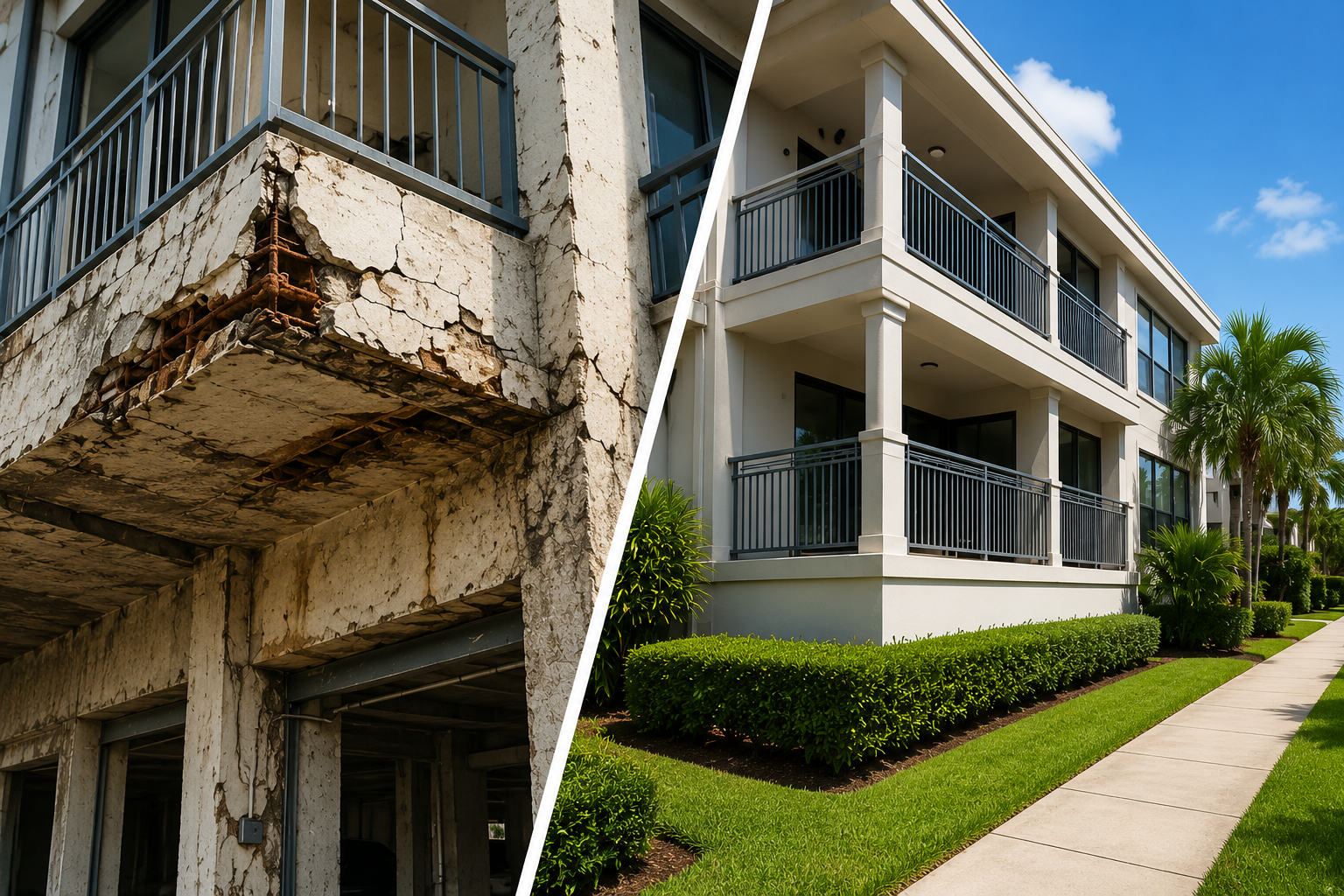

When catastrophic building failures make headlines, they are often described as shocking, tragic, or unforeseen. Residents express disbelief. Board members face intense scrutiny. News coverage focuses on sudden collapse, unexpected evacuation, or urgent structural repair. Financial strain follows quickly, often accompanied by emergency assessments, insurance complications, and legal exposure.
In the aftermath, communities are left asking how something so serious could have happened without warning. Yet in most community associations, catastrophic failures are rarely truly unpredictable. They are more often the result of unchecked deterioration leading to deferred maintenance, supported by insufficient inspections, or optimistic budgeting that left no funds to resolve problems while they were still small.
Building elements rarely fail without warning. Materials age. Systems weaken. Protective layers deteriorate. The warning signs are often present long before a crisis occurs. The difference between manageable repair and catastrophic failure frequently comes down to timing, discipline, and financial readiness.
Smart reserve planning does not eliminate every risk. No community can completely prevent natural disasters or unforeseen structural discoveries. However, disciplined reserve planning dramatically reduces the likelihood that routine aging will turn into a crisis. By identifying vulnerabilities early, prioritizing repairs responsibly, and aligning funding with long-term needs, boards can protect both their infrastructure and the community’s well-being.
Core Insights
- Serious building problems often develop from deterioration that was visible long before an emergency.
- Reserve studies help boards understand what is aging, when repairs are likely to be needed, and how much to budget.
- Regular inspections can identify problems before they expand into larger repairs.
- Underfunded reserves can delay necessary work and increase the likelihood of emergency spending.
- Proactive maintenance and reserve funding give boards more control over timing, contractors, and project costs.
How Do Catastrophic Building Failures Develop?
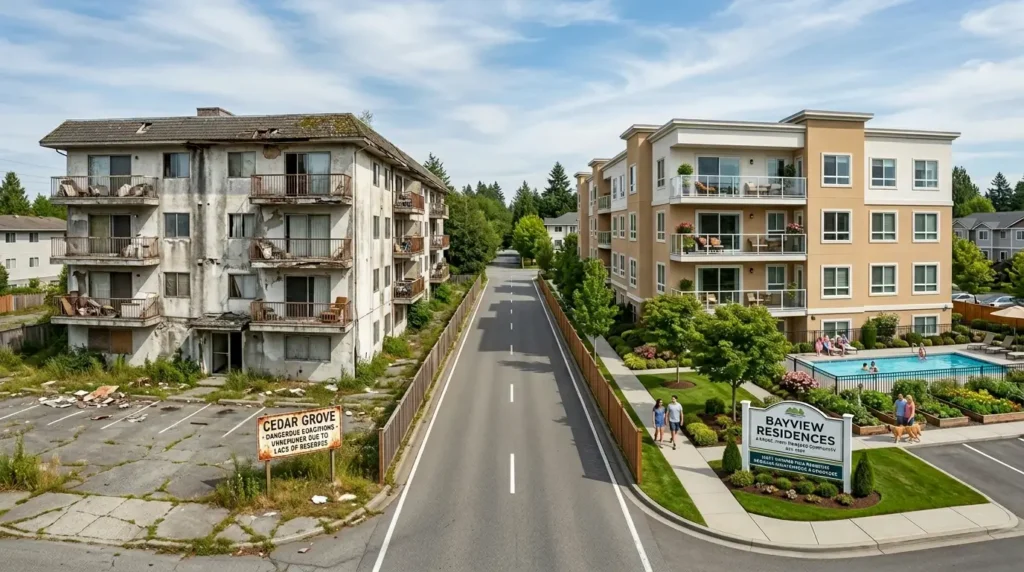
Catastrophic failures rarely begin with a single dramatic event. They typically evolve through a sequence of small, observable conditions that grow over time. Water intrusion weakens structural components. Concrete cracking exposes reinforcing steel to corrosion. Expansion joints fail, allowing moisture to penetrate structural systems. Aging mechanical equipment operates beyond its intended lifespan, increasing the risk of malfunction. Roof membranes deteriorate gradually until protective layers are compromised.
At first, these issues may appear minor. A (minor) recurring leak after heavy rain. A rust stain on the underside of a balcony. Small areas of concrete spalling in the parking garage deck (or ceiling). A pump that requires more frequent repairs. Individually, these problems may seem trivial. Since there “were no concerns” or the issues were minor, structural inspections were skipped.
However, when early warning signs are overlooked or postponed, deterioration accelerates. Moisture spreads. Corrosion expands. Structural elements weaken. And the key is that you unfortunately get used to seeing this deterioration, and don’t notice the growth or progression. What may have been repairable at moderate cost soon escalates into large-scale reconstruction, safety hazards, or even forced evacuation.
The physical damage is only part of the impact. Financial stress follows quickly since these types of projects are a significant and unplanned expense. Emergency contractors must be engaged. Insurance carriers become involved. Residents face uncertainty and potential special assessments. The association’s reputation with local Real Estate agents suffers. In many cases, documentation exists showing that warning signs were present for years, noting areas of concern or areas “to watch”. Maintenance logs may show recurring issues (perhaps documenting the growth of some cracks). In these cases, the problem was not invisibility, it was inaction.
Smart reserve planning complemented with regular (roughly every 5-10 years) competent structural inspections addresses this issue by connecting physical condition with financial preparation. It transforms observations into an action plan, where problems are readily corrected when small.
The Cost of Reactive Decision-Making
When boards operate reactively, decisions are driven by urgency rather than strategy. Emergency conditions limit options. Contractors may need to be engaged immediately, sometimes at premium pricing. Competitive bidding opportunities may be restricted by time constraints. Residents may be notified of large unsettling special assessments with little opportunity to prepare.
Reactive decision-making often leads to inconsistent prioritization. Funds intended for planned replacements may be diverted to address urgent failures. Projects that were scheduled thoughtfully may have to be postponed to accommodate emergencies. Over time, this cycle weakens overall financial stability, as project after project is delayed, inviting future emergencies.
Reactive governance also increases stress for volunteer board members. Urgent decisions must be made quickly, often with incomplete information. It is difficult to move forward when “there are problems everywhere”. The pressure to resolve immediate safety concerns can overshadow long-term planning.
Beyond financial and operational consequences, emergency repairs can erode community trust. Homeowners may question why visible deterioration was allowed to progress, and why small problems were allowed to become large problems. Even when board members acted in good faith, the perception of delayed action damages confidence in leadership. Proactive reserve planning and structural inspections shift associations away from reaction, towards prevention.
How Reserve Studies Help Identify Problems Before They Become Emergencies
A comprehensive reserve study serves as an early warning system. By inventorying major common area components and evaluating their condition, and incorporating the results of the latest structural inspection, associations gain clarity about what is aging, how quickly deterioration is progressing, when intervention will likely be necessary, and how much it will cost.
Professional site inspections, whether by Reserve Study professionals or structural inspectors, often reveal subtle indicators that may not be obvious to untrained observers. Hairline concrete cracking, minor membrane fatigue, drainage deficiencies, deteriorating sealants, or early corrosion can all signal emerging issues.

Reserve Specialists assess not only current condition but also projected life expectancy. They evaluate exposure, usage patterns, and environmental factors that influence deterioration all based on visual inspections and the reports of other subject matter experts (SMEs) supporting your property. Their findings translate physical observations into financial projections.
When boards receive structured analysis rather than anecdotal impressions, they are better positioned to prioritize responsibly. Instead of relying on visible deterioration, to which they have become accustomed, to trigger action, they can rely on professional assessment and planned timelines. Regular updates to the reserve study are important. Construction costs change. Environmental conditions vary. Components may age differently than originally projected. Cash in Reserves changes. Updating your Reserve Study ensures that evolving risks are incorporated into long-term planning rather than allowed to accumulate unnoticed.
Early identification preserves options. Late identification limits them.
Prioritizing Repairs Before They Escalate
Not every aging component requires immediate replacement. Smart planning involves distinguishing between conditions that demand urgent attention, those that can be scheduled strategically, and those that can be ignored.
Reserve studies provide estimated remaining useful life projections, allowing boards to sequence projects in a way that balances safety, cost efficiency, and financial readiness. Prioritization is not about panic — it is about informed sequencing that supports the sustainability of the association..
By performing projects in a timely manner near the end of their service life, associations prevent secondary damage. Replacing a deteriorated roof before widespread leaks develop protects structural framing and interior finishes. Repairing concrete spalling early prevents corrosion from advancing to the point it compromises load-bearing elements. Replacing aging waterproofing membranes reduces the risk of widespread water intrusion.
Timely intervention is typically significantly less expensive than delayed reconstruction. It also allows work to be planned during optimal weather conditions, coordinated with resident schedules, and executed through competitive bidding.
Prioritization turns potential crises into scheduled improvements.
Why Reserve Funding Must Keep Pace With Building Deterioration
Identifying risks and prioritizing repairs are essential, but they are only part of the solution. Avoiding catastrophic failure requires that financial resources keep pace with deterioration.
Underfunded reserves create hesitation. Boards may recognize that a component requires replacement but they delay action because the Reserve balance is “low”. That delay increases risk and may transform a scheduled replacement into a larger scope emergency repair.
When reserve funding aligns with projected needs, boards have the flexibility to act at the appropriate time. Funding becomes a tool rather than an obstacle. Projects can be performed in a timely manner according to professional recommendations rather than in the midst of financial desperation.

Consistent, disciplined funding spreads costs across generations of owners. Each group enjoys use of the property and performs their share of wear and tear experienced during their period of ownership. This alignment promotes fairness and reduces the likelihood that future boards will inherit both aging infrastructure and depleted reserves.
Financial readiness is not about overfunding. It is about proportional preparation.
How Inspections and Preventive Maintenance Reduce Long-Term Risk
Reserve studies are foundational, but they must be complemented by regular structural inspections and condition monitoring. Preventive maintenance programs extend useful life and provide early detection of emerging issues.
Routine inspections of roofs, balconies, parking structures, drainage systems, and waterproofing components allow associations to identify minor defects before they expand. Maintenance plans and maintenance records provide historical context, revealing patterns that may indicate systemic deterioration. Regular monitoring also ensures that repair recommendations are implemented appropriately. Addressing minor issues promptly delays the need for major reconstruction.
When inspections and reserve planning work together, associations create a continuous feedback loop between physical condition and financial preparation.
Strengthening Community Confidence
Infrastructure stability and financial stability are closely linked to community trust. When residents see that their association maintains buildings proactively, communicates clearly about upcoming projects, and avoids surprise assessments, confidence in leadership grows.
Conversely, catastrophic failures create fear and frustration. Owners may question safety, their property values, and governance practices. Even necessary emergency actions can feel destabilizing when they follow years of neglect and visible deterioration.
Smart reserve planning supports transparency. Boards can explain upcoming projects by referencing professional evaluations and long-term funding projections. Gradual Reserve funding increases can be framed as protective measures rather than burdens. When homeowners understand that reserve funding prevents larger disruptions later, they are more likely to support the disciplined care of their valuable property.
Trust is built through predictability.
Legal and Insurance Considerations
Catastrophic failures often bring legal and insurance implications. Structural deficiencies, water intrusion claims, or safety incidents may trigger lawsuits or insurance disputes. Documentation of regular inspections, professional Reserve Study and structural evaluations, and adherence to reserve study recommendations demonstrates due diligence. It shows that the board acted responsibly in maintaining common areas.
While no association can eliminate all liability risk, proactive planning reduces exposure. Addressing deterioration before it reaches critical levels protects both residents and board members.
How HOA Boards Can Build a Culture of Preventive Leadership
No association can eliminate every possibility of unexpected events. Natural disasters, unforeseen structural discoveries, or abrupt regulatory changes may still occur. However, most catastrophic failures linked to aging infrastructure can be mitigated through attentive planning and disciplined funding.
Smart reserve planning transforms uncertainty into structured preparation. It allows boards to identify risks before they escalate, prioritize repairs logically, and maintain financial readiness. Rather than responding to crises, associations operate with foresight and stability. Resilience is not built overnight. It is built through consistent decisions that align physical reality with financial planning.
A Culture of Preventive Leadership (The 4 C’s)
Avoiding catastrophic failures ultimately requires more than financial tools. It requires a culture of preventive leadership that passes from one board to the next, year after year.
Preventive leaders do not wait for failure. They act when evidence indicates deterioration. They care about the property, and have the courage to act. They value professional expertise that satisfies their curiosity about how the property is doing. Then they communicate transparently. They resist short-term popularity in favor of long-term stability, showing they prioritize the property.
This mindset shifts governance from reactive management to proactive stewardship.
Manage the Predictable
Avoiding catastrophic failures is less about predicting rare events and more about managing ongoing, observable and predictable deterioration. Buildings age. Materials wear. Systems reach the end of their useful life. These realities are not surprises — they are certainties.
When boards recognize this and align financial planning accordingly, they reduce risk dramatically. Smart reserve planning ensures that physical aging is matched with financial preparation. It allows projects to be scheduled rather than rushed. It transforms potential emergencies into structured improvements. It saves money.
In doing so, associations protect not only their physical assets but also the trust and confidence of the people who call the community home. Catastrophic failures may capture headlines, but disciplined planning prevents them from becoming the defining story of a community. Don’t let your association become a headline.