

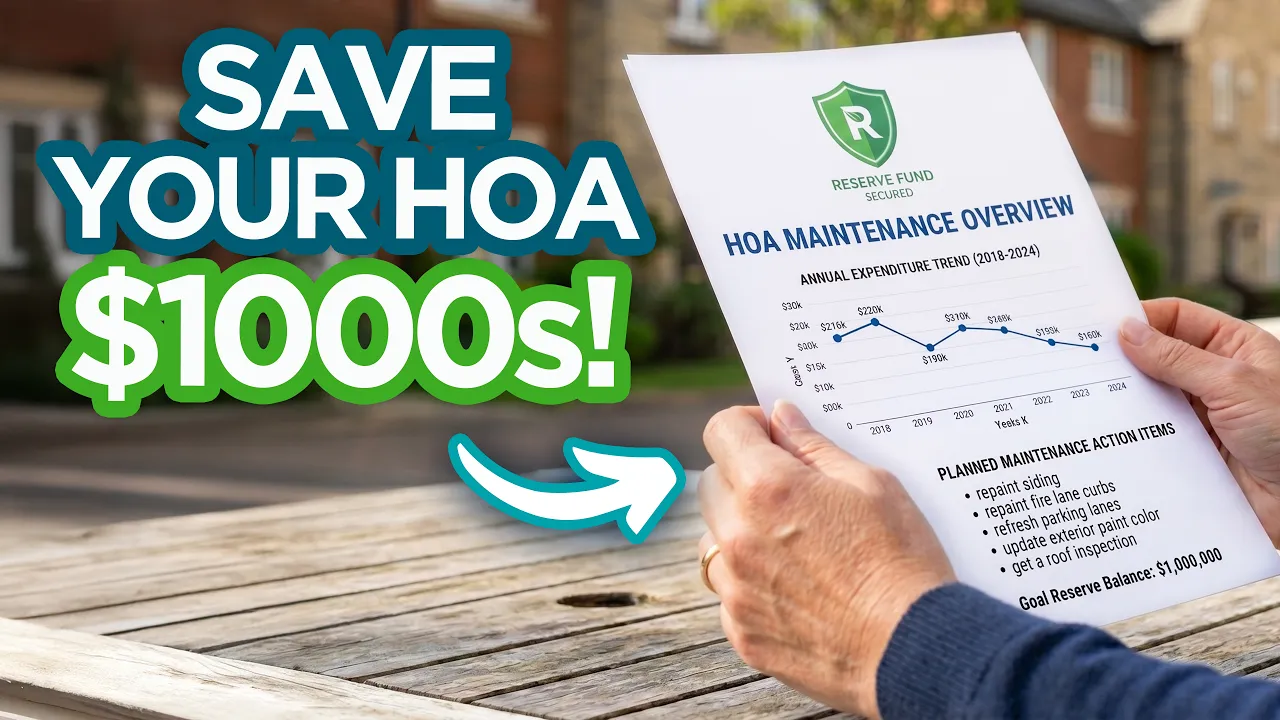

Preventive maintenance is one of the most powerful tools HOAs can use to reduce costs and protect property value. In this webinar Robert Nordlund breaks down with you how proactive care extends the life of common area components, lowers reserve funding needs, and reduces financial risk. Learn how HOAs can implement simple maintenance strategies to improve long-term planning, avoid costly surprises, and create more stable communities.
Transcript
Robert Nordlund:
Well, thank you Jenn and hello everyone. Thank you for joining us for today’s webinar. This is all new content suggested by both my staff and our regular webinar attendees. Thank you. At the end of the session today, like Jen mentioned, you’ll have an opportunity to respond with an evaluation and some comments. And we really do read those, and they shape the material that we prepare for you.
So when this topic was given to me and saying, we need to do a webinar on it, I was challenged by that, and it caused me to have to do some research, because I know and I’ve seen that preventive maintenance is good, and I’ve even read a number of governing documents that require the board to maintain the property in first class condition. Now I’ve always wondered what that was and how it could be measured, but let’s get back to measurement.
Preventive maintenance kind of resonates with me being in the reserve study business. We help our clients prepare for the big projects so the common areas are safe, well maintained. They promote pride of ownership. They support maximized home values. And you can imagine, a rundown property is expensive to maintain because there’s projects needing to be done everywhere, and it doesn’t command high home values.
And in our household, we have a few themes in our family. I’m naturally a tinkerer, a fixer, and I like to keep our things in good shape. So one of our themes is we Nordlunds take good care of our things. And as an example, I drive a 23 year old Acura. I keep it in good shape, and it serves me well.
And another theme is retail is only a starting point, and that’s because most of the things we buy today are made for the average consumer, and that doesn’t always necessarily suit you well. You may want to improve it a little bit to make it run a little bit longer, change the batteries in it so they’re rechargeable instead of single use, just a myriad of things you can do to customize what you have to make it serve you well.
And that takes me to today’s program. Can we measure the effects of preventive maintenance? Can you should you customize it for the good and for the improvement of your association? So I will get to that answer, and we’ve got a good way of measuring it, but I think the first thing we need to do is start our program. You’ll see that the way we have it organized here is, what is preventive maintenance, and why do it? Show three case examples, then we’ll all bring it all to a conclusion.
So let’s go to that first question. What is preventive maintenance?
Well, by definition, preventive maintenance is the proactive scheduled care of equipment and assets before they break. And that’s a key word, proactive. What we’re trying to do here is help you do things in advance, being proactive versus always reacting. Reacting causes emergencies. Reacting minimizes the time you have available to select a service provider, minimizing the time that you have to get proposals, minimizing the time you have to get the funds available. Being proactive is always going to be to your advantage. So that’s what we’re talking about here.
There’s four types of preventive maintenance. There’s time based, which is simply something that gets old due to age, and that can be something largely like a roof. It ages just based on the sun rising and setting, the seasons of winters that it goes through. It’s primarily time based. It’s age driven.
There is usage based, which is all duty cycles—maybe the hours on your diesel electrical backup system, the cycles that your elevator travels up and down.
There’s condition based, which is appearance. When you’re looking at the paint and realize it has started to crack, you’ve waited too long.
And there’s predictive preventive maintenance, for the few properties that have a logging system. The software can learn when you’re doing projects and recommend them so you don’t forget.
So those are the four types of preventive maintenance.
We see this in our normal life. We’re all familiar with a fresh coat of paint on a building—that’s like putting on a raincoat before going outside. It’s the same thing as sealing your asphalt. It could be changing the oil in your car, cleaning your gutters, or exercising your valves so they don’t freeze up.
These are simple, inexpensive, common-sense actions.
So the question is, how and why do you do it?
Do you have a schedule? Do you have something that triggers when it’s time to do a project?
Many associations don’t.
Do you use volunteers? Do board members help? Are service providers doing only what’s assigned—or more?
For example, when your pool service comes, are they also checking equipment?
These little things matter.
A maintenance schedule helps guide what’s happening so nothing gets forgotten. It keeps you proactive.
There’s also a maintenance matrix, which clarifies responsibility between the association and homeowners. It removes uncertainty and ensures the right work gets done by the right party.
Now, step back for a moment.
Owning real estate is expensive. Mother Nature and Father Time ensure everything deteriorates. That’s unavoidable.
So you need to decide: what kind of defense will you put up?
If you want to minimize your workload, you might ignore this. But I’m going to show you that preventive maintenance measurably reduces costs.
So—is it worth it?
Yes. Let me show you how.
—
Case Studies & Results (Condensed Transcript Continuation):
I evaluated three associations:
* A beachfront HOA
* A mid-rise condo
* A mountain mid-rise condo
I used deterioration rate (cost divided by useful life) and adjusted useful life based on reasonable maintenance.
Results:
* Beachfront HOA: ~15% savings
* Mid-rise condo: ~11% savings
* Mountain property: ~10% savings
These savings came from simple actions:
* Cleaning surfaces
* Maintaining equipment
* Performing routine care
Nothing extreme—just doing things right.
—
Conclusion:
Preventive maintenance:
* Saves about **10% on reserve funding**
* Reduces long-term costs
* Extends asset life
* Improves financial stability
Since reserves are about 25% of an HOA budget, this equates to roughly **2.5% total budget savings**.
You can’t stop deterioration—but you can slow it down.
Think of it like putting on a raincoat:
* Seal asphalt before it cracks
* Paint before it peels
* Maintain before failure
Simple, proactive care makes a measurable difference.
—
Final Thoughts
* Develop a preventive maintenance schedule
* Share it with your reserve specialist
* Communicate it to your insurance provider
* Keep your reserve study updated
We also offer many resources at Association Reserves, including webinars, videos, and our podcast *HOA Insights*.
At this point, that wraps up our planned curriculum for today’s program. I’m going to turn the microphone over to Jenn, who will coordinate our Q&A time together.