

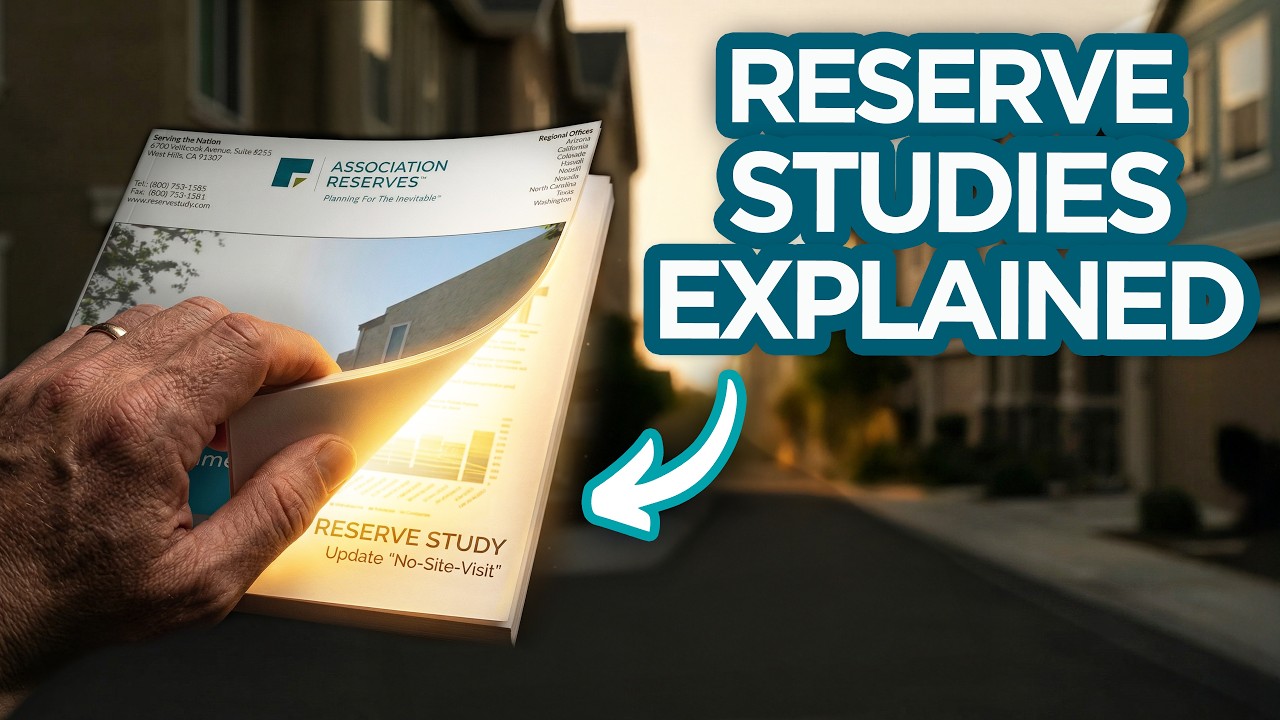

A reserve study is one of the most important tools for HOA financial planning. Learn what a reserve study includes, how it evaluates your HOA’s financial health, and how it helps predict future repair and replacement costs. Understand percent funded, funding plans, and how to avoid costly special assessments.
Transcript
0:07 – Robert Nordlund:
Well, thank you, Jenn, and hello, everyone. Thank you for joining us today for this webinar on
what is a reserve study. Now, in prior webinars, we’ve talked about different technical aspects
of a reserve study, diving into the details.
We’ve also had guests on the program talking about what they contribute to a reserve study.
But today, we wanted to back up a little bit and say, well, who’s it for? What’s in it? And what
does it do? And this was driven by some recent events in the news and some recent people that
have been in contact with me. I’ve been contacted more recently by lenders asking for details
about the reserve study and for insurance representatives and board members together
talking about what can we do to lower our insurance premiums? How can we work together?
What do the insurance companies want to know? What are they looking for in the reserve
study? And how can we work together for the best interests of the association? So, it’s time to
have a webinar talking about, indeed, what is a reserve study.
And it starts with the idea of the parties involved. And I want to make it very clear that
perspective is critical to understanding. Different people are going to see the same thing
differently.
And when I was crafting this webinar, this is the image that came to mind. I’ve seen this in
paintings before, and I liked finding this simple little graphic. You can see the different people
touching an elephant or meeting an elephant, blind people.
The first time they might see it, you can see the person on the right thinking, oh, it feels like a
rope. The person on the left says it feels a lot like a pointy thing, a spear. Or the woman by a leg
says it looks to me like it’s a tree.
We’re going to use this idea that perspective is important and it guides your understanding and
your expectations of what a reserve study is. But since all we do is reserve studies here at
Association Reserves, we want to take this idea of this complex elephant-ish type thing and tell
you right from the beginning, well, what is it? What is this elephant thing? And so, taken straight
from National Reserve State Standards definition, or you can read along with me, a reserve
study is a budget planning tool that, number one, identifies the components a community
association is responsible for maintaining or replacing. Number two, the status of the reserve
fund.
And three, a stable and equitable funding plan that offsets those anticipated future major
common area expenditures. So, there you get a hint that it is multifaceted, just like sometimes
you see someone riding on an elephant, so is it a mode of transportation? Someone using an
elephant’s trunk and tusks to maybe lift something heavy? Maybe you’ve seen it with a harness.
Maybe it’s pulling something heavy.
So, there’s different things an elephant does. And so right from the start, there’s three things
that you should find per National Reserve State Standards in a reserve study. Now let’s show
those three things looking like this.
The foundation is the component list. Then we’ll calculate the reserve fund strength after we
compare cash in the bank to the needs of all those components. And then based on that
financial starting point, we’re going to craft a funding plan.
So, this is important, so I want to go a little bit further into it. So, three parts, the component list
is what’s there at your association and what condition it’s in. Second part is reserve fund
strength, where we calculate, okay, based on how much cash you have, how really does that
match up? We have $500,000.
Do we feel good about that or bad about that? That’s kind of where we’re going with that. And
then the funding plan is based on that financial starting point, how much cash do we need to
be setting aside on an ongoing basis from here to maintain our properties? We have the right
cash at the right time. So those are how those three things are going to work together.
If all you care about is the budget number, then maybe you don’t look at the other two. If all
you care is the components, again, maybe you don’t look at the other two, but all three
together, they form a reserve study. And another fundamental thing that drives the
preparation of reserve studies is that owning real estate, maintaining real estate is
fundamentally expensive, and that’s driven by mother nature and father time.
They see to it that everything is in a constant state of deterioration, and so that makes it
eventually going to hit the time where it needs a major repair or a replacement. So, this idea of
reserves are not driven by legislation, it’s not driven by your governing documents, it’s not driven
by board member philosophy or even maybe a policy statement that the prior board left you
with. You do a reserve study because everything is in a constant state of change and you need
to know, okay, how are we going to move this association forward? Us and all the outside
parties, a reserve study gathers this information together that other people are going to want
to see.
So, it’s the deterioration that defines the cost. Basically, I guess I should say the developer said,
let’s design this kind of buildings. And so, per construction, you have a certain amount of roof,
you have a certain amount of asphalt, and based on those common areas, how fast they
deteriorate, that’s driven by mother nature and father time.
The cost is going to happen no matter if you fund it or not, okay? So, it is up to the board to set a
budget that keeps up with that deterioration so that there is money collected from the first 20
years of members to pay for that first roof, okay? Now, I put an asterisk there because in
general, board members have the power to set a budget for the association. In some
associations, based on their governing documents or state law, the members, the
homeowners, either get to vote to approve it or vote to deny it or things like that. But mostly it’s
the board’s job to set a budget that keeps up with what needs to happen at the association.
And then, again, according to the governing documents, homeowners, the members of the
association, they’re responsible to pay their share. And that share may be an equal share based
on the number of units there. It may be a proportional share based on larger or smaller.
I’ve seen high rises where the penthouse homeowners pay a significantly larger amount just
because they’re the premium owners. And they’re the ones that derive the property values at
the association, and so they pay a higher amount. But that’s all defined by the governing
documents.
So that’s the teamwork here. And already you can sense that there’s multiple parties involved.
The board, the homeowners, those two need to work together and have success at the
association.
And I’m going to suggest that there are even more threes. We talked about those things on the
last slide. But of the components, there’s yet a three-part test to define which projects are
appropriate for reserve funding.
And then of the reserve fund strength calculation, there’s three ranges, pretty simply. It’s the
weak, the fair, and the strong. Or good, fair, poor, but it’s three ranges.
And on the funding results, there’s three goals. A risky baseline goal, a conservative full funding
goal, and there’s the threshold goal that is at some threshold in between. But I’m not going to
go down that too much.
I want to spend time on the main content of this, how it’s viewed, what it’s for. But I want to
make it clear that the reserve study itself is not fundamentally very complicated. It’s three parts
of it.
And for its major three parts, each has three parts of that. So, it’s nothing with a 17-part
checklist, nothing that is advanced calculus. It’s just some pretty simple fundamentals.
So straight to the parties. Let’s talk about the boards and the homeowners. It seems like that’s
a majority of who’s with us here today.
Of the boards and the homeowners, they’re looking for, okay, we live here, we own here, it’s
ours. I have a fractional interest in this not-for-profit corporation, and it’s where I live. I bought
it, so it has some value.
How do we responsibly run our association forward into the future? What’s that going to take
budget-wise? How are we going to prepare? Just like any business that needs to prepare for its
major cash drops when they need to, oh, if you’re a hotel, you need to plan ahead for a new
roof, a new elevator, taking care of the asphalt. You want to responsibly collect the right
amount of money and have it set aside so you can take care of the place. So, the question is,
what does it cost on an ongoing basis to be a part of this association? I’m a member here.
What’s that mean to me? And does our association have enough money now? And are we on
trajectory? Are we on plan to have enough money when we need it in a few years for that X
project? Painting, roofing, asphalt, elevator, new carpeting in the hallways, whatever it is. Are
we on track for it? And so, these are the kind of questions that the homeowner members are
going to ask because they have a financial interest in co-owning homes at the association. Now,
let’s shift to the insurance professionals.
OK, they are not owners. They’re trying to provide a service to the association. They’re looking
at the reserve, say, wondering what can they learn about the association? Are most of the
components OK or are most of the components near the end of their useful life? And what are
the next big projects coming? Are the next big projects coming soon or are the next projects
just kind of relatively trivial, just a pool furniture, maybe painting the ironwork around the pool
or something like that or entry intercom system? Those are relatively small compared to the big
ones.
So, the insurance professionals are asking what’s around the corner and then are they, the
association, is the association on pace to maintain what they have? Are they funding per the
reserve plan? Are they doing their part to take care of the place? Or are they just closing them
eyes, putting their hands over their ears and crossing their arms saying, we don’t care, we got
insurance. Insurance companies don’t like that because that just means that the association is
pushing risk over to the insurance company. That means higher payouts and that’s going to
mean higher premiums.
So, in addition, there’s a side question. Are there other risks there that are not even on the
reserve? Is this a lakefront property with a dock? You and I think of, or I think of the pool as how
often do we need to resurface it? Is it attractive? Is it well presented? But an insurance company
looks at how much risk there is of accidents around a pool. Are there old balconies there that
could also provide some health or safety risks? And the insurance professionals are looking for,
okay, I see that, but that was three years ago.
I see that, but that was five years ago. So, they’re concerned with how old is that reserve site? I’ll
touch on that more in just a couple of minutes. The mortgage lenders, I’m separating this from
the lenders that are lending to an association for an association’s common area project.
Although there are some similarities, but primarily for the mortgage lenders, they’re asking and
they have a simple time-tested metric. How much of total budget is the association setting
aside towards reserves? And for many years, that’s been 10%. They want to see at least 10%
going towards reserves.
I’ll speak more on that in just a little bit. And then when are the next big projects coming? Does
the association has enough cash? Are they prepared for these projects or are they going to be
unsettling? Because the mortgage lenders want to know for the person paying the mortgage,
they want to make sure that person has plenty of money to pay the mortgage. And so the
lenders are concerned about extra bills that that person paying the mortgage will have to pay.
So, lenders don’t like special assessments. Lenders don’t like really big projects on the horizon
and then underfunded reserve fund. So, they’re also wanting to know, is the association
budgeting per the reserve study? If the reserve says you should be setting aside $10,000 a
month and the association are only setting aside $5,000, they note that and they realize that the
association is not on trajectory to successfully get to the future.
And you think, how long is a mortgage? Typical mortgages are 30 years. And so, the lenders
have a long-term view. They want to make sure that the association is stable for the long term.
So, they want to see the association budgeting per the reserve study. So, it’s not just a short
term, hey, let’s give our members a break for a couple of years. We’ll deal with that in the
future, special assess for it in the future.
Lenders don’t like that. And again, they’re also looking at how old is that information? That was
five years ago. Five years ago, was, wow, 2021.
We’re still in the pandemic, still in years of high inflation, still thinking about supply chain
issues, maybe some shortages of some products that we were trying to purchase. So, lenders
are concerned about how old is that reserve study. The line they’ve drawn in the sand is three
years.
They want to see a reserve study that is three years or newer from the date of the loan
application. So, let’s change the subject now and talk about what a reserve study is and isn’t.
And first, we’ll talk about what it is.
It’s a disclosure document, a disclosure document for this purpose of this slide. And I’ll go down
this path a little bit. It’s what’s there, what condition is it in, what will it cost to replace, and
when will that be? So, we’re looking at the physical attributes of the association, identifying the
cost, identifying the useful life, identifying the remaining useful life.
That’s a disclosure as of a certain point in time, okay? If you find out that our association’s wood
trim needed to be painted immediately, but it’s a three-year-old reserve study, then the lender
is going to wonder, your homeowner is going to wonder, the insurance company is going to
wonder, did they take care of that or are they letting that rot away? So, in the reserve study
industry, we consider a reserve study a one-year document. So, check the date on the cover.
Different providers sometimes will say it’s for this fiscal year.
Hopefully that’s pretty clear. And though I hope you all know that in this reserve study
business, we look forward at least 30 years into the future, and that’s so we can set the budget
aside, the right amount of funds aside to get ready for those big future projects. But we
consider a reserve study a one-year document.
Provides information that is accurate and will stand behind for one year. So that’s an idea here.
Why? Gee, you’re looking forward 30 years.
Well, I have zero expectation I can walk away from even our best reserve study, come back in
17 years, and see all our predictions come true. That just doesn’t happen. We’re in this idea that
it needs to be regularly updated, and that’s because the following basic elements of a reserve
study is in a continual state of change.
It’s the three Cs. The condition of the components, how they wear and tear through the years,
the cost of the components, how they change their price based on generally inflation,
sometimes scarcity, or again, supply chain issues, and the cash in reserves. Have you spent it?
Have you collected it? Is it growing? Is it growing well? At this point in time of the recording,
hopefully our clients are getting four-ish percent on their money in reserves.
Growing nicely. This cash in reserves changes on an ongoing basis. National best practice
defined in national reserve study standards is to perform a with site visit update at least every
third year with an annual no site visit update in the in-between years.
That’s in national reserve study standards. It’s from this same concept that the lenders are
looking for a reserve study prepared within the last three years. I can tell you, if you’re in a state
that only requires a reserve study every fifth year, when we update one of those, we consider
that a rescue.
It’s so far out of date. Whereas, I can tell you this, a little over 60% of our clients update their
reserve study every year. That’s because we make it very inexpensive with that no site visit
update.
And because at that point in time, after just one year, it’s a minor tweak. It’s not unsettling to
the association. So good things happen.
All right. It’s a disclosure document in a different way in that we say, based on your cash now
and the components now, how does that cash compare to your needs? And that balance, that
comparison is called percent funded. And it’s a measure of the amount of cash you have to the
amount of deterioration at your association.
When they are in balance, then you are 100% funded. And then next year, everything at your
association gets a little bit older and the deteriorated value gets a little bit larger. And so
therefore, you should be setting aside, continuing to set aside funds towards all that
deterioration.
And if you paint the project, then your deterioration is less, your requirement is less. But then
again, your cash is less because you spent $100,000 painting it. So, it’s a matter of keeping a
balance between the cash you have and the deterioration at the association.
And then to the third element of a reserve study, it is a budget plan. It’s helping you know how
much to set aside in reserves on an ongoing basis to offset the steady, ongoing deterioration of
the common areas. Now, I want you to think of it like I’ve shown here in this slide, like an
hourglass.
It’s steady, gradual, ongoing deterioration. Don’t think of it like that roof project or that elevator
project. Deterioration happens on a day-to-day, sand-through-the-hourglass type of manner.
So, this budget plan is how much to set aside funds on an ongoing basis so that you can
successfully get to the future. So, we are not foreseeing accidents. That’s what an insurance
company does for you.
They look around, they check their statistics and probabilities, and they say, this is possible to
happen, this is likely to happen, and therefore this is how we set your premium. We’re not
looking for potential accidents, but major projects that are reasonably predictable. So, we’re
looking at the things that will happen, not just possible, but things that will happen.
Now, that said, we’re not looking into the future. We kind of do help you see into the future
because the amount of cash you’re putting into reserves is hopefully just a little bit compared
to how much is already there that you’ve accumulated over X number of years as your assets at
your association age. But what I want to explain is that based on your percent funded, we can
tell you what your risk is of a special assessment.
And if you’re in the 0 to 30% funded range, in this red range here on the left, any time you’re in
these three percent funded range bands, you have roughly a 50% chance of getting hit with a
special assessment because you just plain don’t have the cash. You want to know that, your
homeowners want to know that, and you want to get your association out of the 0 to 30%
funded range. You want to get them into the fair range or into the strong range.
So, knowing your percent funded, you get a little glimpse of the future. What are we up against,
all right? And also, in addition to you homeowners and board members, lenders, the sellers
themselves, and the real estate agents care a lot about this. The sellers, the buyers should be
caring because this is how they could see a special assessment coming.
If they’re going to pay $500,000 for a home and it’s going to be a $10,000 special assessment in
a year or two, they might want to negotiate that from the selling price or the purchase price.
Okay, now let’s talk about what it is not. A reserve site is not just an overall inventory of what’s
there.
Yes, a component list lists a lot of things, but it’s only the major projects that are reasonably
predictable. We’re looking for the major common area budget items that are reasonably
predictable that we need to prepare our client for financially. It’s not a safety inspection.
Don’t expect us to be looking around with safety goggles on, looking for dates on inspection
stickers, things like that. We are looking for normal deterioration over time. So, a reserve site is
not a safety inspection.
Sorry to the insurance agents on the webinar, but this is fundamentally outside of our scope of
work. It’s not a structural inspection. We are looking for the patently obvious, the visible
deterioration without any intrusive or destructive testing, deterioration of properly built
components.
A structural inspection is a fundamentally different thing. It’s a different specialty, different
training, different standards. And if you have major building assets and you’ve crossed the 10
years old time frame, you should have a structural inspection.
Typical interval there is somewhere in the 5-to-10-year range, depending on the significance of
what you have. It’s also not a construction defect evaluation. We are not looking at how your
association was built and then comparing it to plans or construction standards.
So, if I’m the guy here in the picture, I’m looking at the condition of the wood and does it need
to be stained and sealed? I’m not measuring what’s the distance between those, the bracing.
Was it a different distance between the, yeah, you know what I’m saying. And was that light
sealed properly to keep water from getting in behind the siding? So don’t expect this to be a
construction defect evaluation.
That’s a separate specialty. And so, you can see how there’s a lot of different ways people may
have thought the reserve study was going to help them. And I want to make it clear what a
reserve study is and isn’t.
So, we asked the question, what do you learn from a reserve study? Depending on your point of
view, what kind of information is in there? And for the mortgage lenders, they’re looking
primarily for is the association inviting special assessment risk on its members. Is some
stumbles or lack of leadership or financial problems at the association level going to cause a
special assessment that’s going to destabilize their nice homeowner who is just on the verge of
being able to afford this home. So, as I said before, the mortgage lenders are looking for the
magic percentages of reserve transfers compared to total budget.
And in the past, that’s been 10%. As of March 18, Fannie Mae and Freddie Mac both announced
that that number is going to move to 15% in January of next year. They’ve given us all advance
warning.
So not really a big deal because as I’ll show later, the normal amount going to reserves needs
to be somewhere in the 15 to 45% range. So, increasing the minimum standard from 10 to 15%,
no big deal. They’re looking for what are the total expenses in the next five years.
Again, they’re looking for anything that might destabilize the association. Is there a tidal wave
coming that is going to knock the association backwards and the association therefore special
assessing the members? And it’s all driven by Fannie and Freddie. They control, I’ve heard
different numbers, 60 to 70% of the mortgages in this country, residential mortgages.
You want to comply with their standards because that will give prospective homeowners and
any homeowner refinancing favorable rates. And we all want favorable rates, especially when
rates are so high. And they are looking if the association is funding per plan.
Are they following the recommendation or are they drifting sideways or even going backwards
in some cases? Insurance professionals, they’re looking at how well is the property being
maintained. They’re looking at if the association is taking agency for maintaining its own self.
Are they just, again, waiting for things to fail, potentially inviting accidents? And boy, insurance
professionals hate hearing that because they’re going to say, if you’re inviting accidents, we’re
inviting you to pay a higher premium.
And then they’re also looking, does the association have the dollars to maintain itself? They’re
looking if you’re funding per plan. They want the association to do its part, handling the known
projects that can delay or eliminate so many accidents. So, for the boards and homeowners, this
may be familiar to the majority of our audience.
The component list says, what do we have to maintain? What are we up against? What are the
mountain that we need to climb? Second, what is our percent funded? How are we doing right
now? How good of a starting point do we have? And the third is, based on all that, what’s going
to happen to our recommended funding? Are our homeowner assessments going to go up?
And that’s a very good question. And I probably outlined that you’re going to learn that. But let
me ask a slightly different question.
Does the budgeted reserve funding change the cost of living at the association? Okay. If we say
you need to increase your reserve funding from $5,000 a month to $6,000 a month, does that
increase the cost of living at your association? Average person is going to respond, of course,
it’s very simple. When things go up, everything gets more expensive.
But I’m going to suggest the answer is no. The cost is unchanged. That roof is going to fail.
The asphalt is going to fail. The only choice is, are you going to pay for that via a special
assessment because you’ve waited until the bill actually happens? Or are you going to pay for it
via budgeted funding, spreading it out nice and fairly, nice and evenly over time? So, the cost is
the cost. Reserve funding doesn’t increase the cost of living at the association.
It just means that you’re going to be paying your fair share over time, not via a special
assessment. And what is that number? I said earlier, but I want you to have a visual. Reserve
funding among our clients.
We’ve looked back to the over 100,000 reserve stays that we’ve prepared. Reserve funding,
sufficient reserve funding is typically 15 to 45%. Typically, 15 to 45% of the average association’s
budget.
It needs to be. It’s a significant expense. I said earlier, owning and maintaining real estate is
expensive and I meant it.
The average, if you were to ask me, what should we be doing? I’d say set aside 25%. I can give
you that for free. You’re going to learn the actual number in your completed, updated reserve
study.
This file is longer than 30 minutes.
Go Unlimited at https://turboscribe.ai/ to transcribe files up to 10 hours long. And you may be saying holy moly, nobody can spend that much. And I probably choose a chose a poor word there, because it’s really investing. All you’re doing is setting it aside, and that way it’s sitting there, growing with interest for the next roof project. So, no one can fund the reserves appropriately, that’s just way too much. And the answer is, you’re wrong. What we see among our clients is that about 26% of our clients are in that strong range, 70% or higher. About 40% are in the fair range, 30 to 70% and about 34% pretty close to 1/3 is in the weak range. Those are the ones making all the news, making all the squawks. They’re the ones having all the special assessments. You want to get out of the red range and join the fair club. And if you’re in the fair club, you want to slightly increase your reserve funding. You want to move from the fair range into the strong range by slightly increasing your reserve funding. And with that, we’ll get to the conclusion. So let me bring this program in for a landing. Some of the ideas to learn is that a reserve study gets out of date. It’s a perishable commodity. So, update on the basis of a diligent visual site inspection, a West site visit update at least every third year. And again, the three C’s, the costs change, the conditions change, and the cash and reserve changes. So, it requires rebalancing. It just does if you think, Boy, that’s going to be expensive. Well, no, every Association should have a full reserve study to start their reserve planning. After that, it’s a matter of update with site visit and update no site visit reserve stays, each less expensive than that initial full reserve study. And again, if we look back over our now, well over 100,000 clients, our average cost among our clients for reserve a reserve study, I think it’s point eight, 4% little less than 1% so whatever you’re paying for a reserve study, it’s going to be a relatively small number, and it’s not a big obstacle. So, keep thinking that there’s not a whole lot you can do for the costs at your association. Maybe you can take good care of your fence, painting it regularly. Maybe you can clean your gutters on your roof regularly, extending your roof life. But there’s not really a whole lot you can do.
Owning and maintaining real estate is expensive, and doing that will stretch your useful life estimates and so it will slightly lower your reserve funding obligations. But you have to get the idea that reserve funding is going to cost something in the range of a quarter of your total budget. And to get that number, you need to get a reserve study. You need to update your reserves day. So, your reserve study, whether you’re an owner, as a homeowner or a board member, an insurance professional or a lender, reserve study is going to be your guide to the information you need to find out. Now, we’ve got additional resources at reservestudy.com there’s an option at the top right to request a proposal. Lots of great information resources on our website. We also have a vast library of videos on YouTube, so you can either find them on reserve study.com or you can go to YouTube. If you search for reserve study on YouTube, you’ll likely find our content. Subscribe to our channel, and you’ll get regularly notified when we have something new. And we also have a great resource. It’s a weekly podcast for board members, 30 minutes of inspiration and education, very encouraging. It’s called HOA insights, common sense, for common areas. You can subscribe from all major podcast platforms, or listen from hoainsights.org or you’ll also find it on our YouTube channel. If you’re a reader, we’ve got a book. It’s called Understanding Reserves. You can get it on Amazon. I’ve got a copy here on my desk that I will give to someone today who asks a great question. So, queue up your questions here, and maybe I’ll send you a signed book. And with that, I’m at the end of our prepared content like to turn the microphone over to Jenn who will coordinate our Q and A time together.