


Often, our webinars address particular parts of a reserve study: how to read them, legal responsibilities, or other specific concepts. But, we’re going to be addressing the underlying strategy, the three basic options you have to solve the problem of Mother Nature and Father Time, day after day after day, moving all your common areas from new condition all the way to needing to be replaced. It’s a battle, and we want to set you up for success now. By the end of the program, you’ll have a clear understanding of the choices you’re facing, the pros and cons of those options, and you’ll be armed with sound bites you can use to communicate what you are doing to your homeowners. We want them to be alongside you, supporting you in your job to maintain the common areas.
Transcript
Robert Nordlund:
Well, thank you, Jen, and hello, everybody. Often, our webinars address particular parts of a reserve study—how to read them, legal responsibilities, or other specific concepts. But today, we’re going to be addressing the underlying strategy: the three basic options you have to solve the problem of Mother Nature and Father Time, day after day after day, moving all your common areas from new condition all the way to needing to be replaced.
It’s a battle, and we want to set you up for success. By the end of today’s program, you’ll have a clear understanding of the choices you’re facing, the pros and cons of those options, and you’ll be armed with sound bites you can use to communicate what you are doing to your homeowners. We want them to be alongside you, supporting you in your job to maintain the common areas.
I’ll start us off by talking about the situation we’re facing, and then I’ll hand things off to Brian so you can benefit from his expertise.
To start, you have to understand the fundamental issue that owning real estate is expensive. It starts when you purchase real estate, but it doesn’t stop there. Mother Nature and Father Time see to it that everything is in a constant state of deterioration. So it costs money to maintain that real estate. It’s not something that you buy and then you’re done. You have to appreciate that you’re going to buy it and then regularly repair and replace different elements of what you’ve purchased.
At a community association, there are two kinds of space. There are the common areas—those are the things that are the association’s responsibility—and the private spaces, which are what individual owners own and maintain. That’s going to be different between a condominium association and a single-family home HOA, but the idea is that there is this division.
That’s important because it’s the board’s duty to sustain the common areas. They’re responsible for that, and that comes from the governing documents. The board has a legal responsibility to make the decisions, put in the time, gather the budget, hire the appropriate service providers to fix things when they break, replace things when it’s time, and basically sustain the common areas.
Everyone is responsible for their own private space, whether that means replacing their television, couch, carpet, or whatever is private to them. But it’s the board’s job to take care of all the things that are common areas.
Think about a parking lot that’s beat up where cars have been driving and parking on it. I want to make sure you understand that deterioration is not evidence of your failure. Deterioration isn’t because you failed to maintain it. Deterioration is driven by Mother Nature and Father Time. It’s part of living on planet Earth.
Your roof, pavement, siding, and elevators are all decaying day after day. That’s foundational to life on planet Earth.
Now, I don’t want you to get depressed or discouraged and think, “Oh no, that’s hard.” It may be expensive, but it’s not particularly hard because all these major component deterioration issues are predictable. You can plan for them. And if you can plan for them, you can budget for them, so they’re not going to catch you by surprise.
As I said, every association has two parts: the private spaces and the common areas. Every association also has two types of obligations.
There’s the operating fund. Those are the regular daily, weekly, and monthly bills. Generally, those are things where you get a bill in the mail. It’ll be insurance, management, utilities, pool service, janitorial, landscaping, and things like that.
Then you have the reserve obligations, and that’s the ongoing cost—the ongoing deterioration cost—of major assets as they get older.
That’s a current cost that is just as real as the operating costs.
I want to make that very clear. Both are real, both are current costs, and both are the board’s job to fund.
Where we’re going today is to make it clear that reserve funding isn’t charity. It’s not a contribution for the future. It’s not a contribution for someone else’s roof project 13 years into the future.
Reserve funding is paying today’s share of a cost that is accruing today, every week and every month.
That asphalt is getting a little more deteriorated. The roof is getting a little closer to the time it needs to be replaced. The siding is getting a little drier. The paint may be getting drier and closer to chipping. That’s all happening on a day-to-day and month-to-month basis.
What we’re trying to do is make sure you don’t get into a situation where you’re asking someone in the future to pay your usage-fee bill for reserves. We want to make sure you’re set up to carry your part of the obligation as your common areas gradually age and deteriorate.
So, to say it plainly and give you the first sound bite of the day, reserve funding isn’t about being generous to future owners. It’s not providing them cash. It is about not stealing from them—not making them pay your usage bill.
That’s the usage bill you built up while you lived at the association for the last five years, 10 years, or however long it is. You’re developing an obligation, your usage fee, and it’s our job to help you understand that it’s your job to pay that on an ongoing basis.
At this point, let me turn the microphone over to Brian, and we’ll talk about strategy for your association.
Brian Weaver:
Thanks, Robert. Thank you, Jen, and welcome to everybody here on this webinar. We appreciate you being here.
We’re going to walk you through this and give you hope and a plan to be able to move your associations in the right direction.
There are three ways to pay for any project. Specifically, we’re talking about large-scale projects here. You can gradually save and do that year after year. You can pay when it fails, and obviously that’s usually a last-minute decision. Or you can borrow after it fails and then pay it off with interest.
Those are the three main ways. There’s a fourth way, which is just a combination of the other three, but for the purposes of this webinar, we’re going to focus on these three.
The first option is saving while the asset is still aging. That’s what we’re talking about in terms of proper reserve funding.
Think of a hotel or a gym. They’re charging you a rate, and you’re paying that rate. From that money, funds are going toward the eventual replacement of those items—the hotel furniture, the gym equipment, and so on. It’s built into what you’re paying.
The second option is paying when something fails. Think of a single-family homeowner. Unfortunately, you’re sometimes faced with a roof going bad. You knew it was going bad, but now that $20,000 expense hits you, and you’re forced to replace that roof or water heater. Oftentimes, it comes with chaos. It’s a last-minute decision that needs to be made, and unfortunately, it often comes with problems.
The third option is that the roof fails, or you have another unplanned major expense, and rather than coming out of pocket and writing the check from your own checkbook, you go to the bank and get a loan. You get the money now and pay it back over time.
That’s the most expensive of the three.
When we talk about these different options, it’s important to remember that you don’t control the costs. They’re coming either way. There’s nothing you can do to prevent that roof project from eventually needing to be done, but you do control how that cost is paid.
The options range from the least expensive to the most expensive.
The least expensive is doing it properly. It’s funding through the reserves, putting money aside month after month and year after year, allowing your reserves to build while also collecting interest. You’re actually making money on your money.
The second option is a special assessment. That’s all at one time. You need $20,000 for the roof, you have the money in the bank, and you write the $20,000 check at that particular time.
The third option is the most expensive, and that’s borrowing. Instead of making money on your own money in your account, you’re paying the bank for the use of their money.
I love the example we’re using here because it really gives us a visual of what we’re talking about, and these are real numbers from a real-life example.
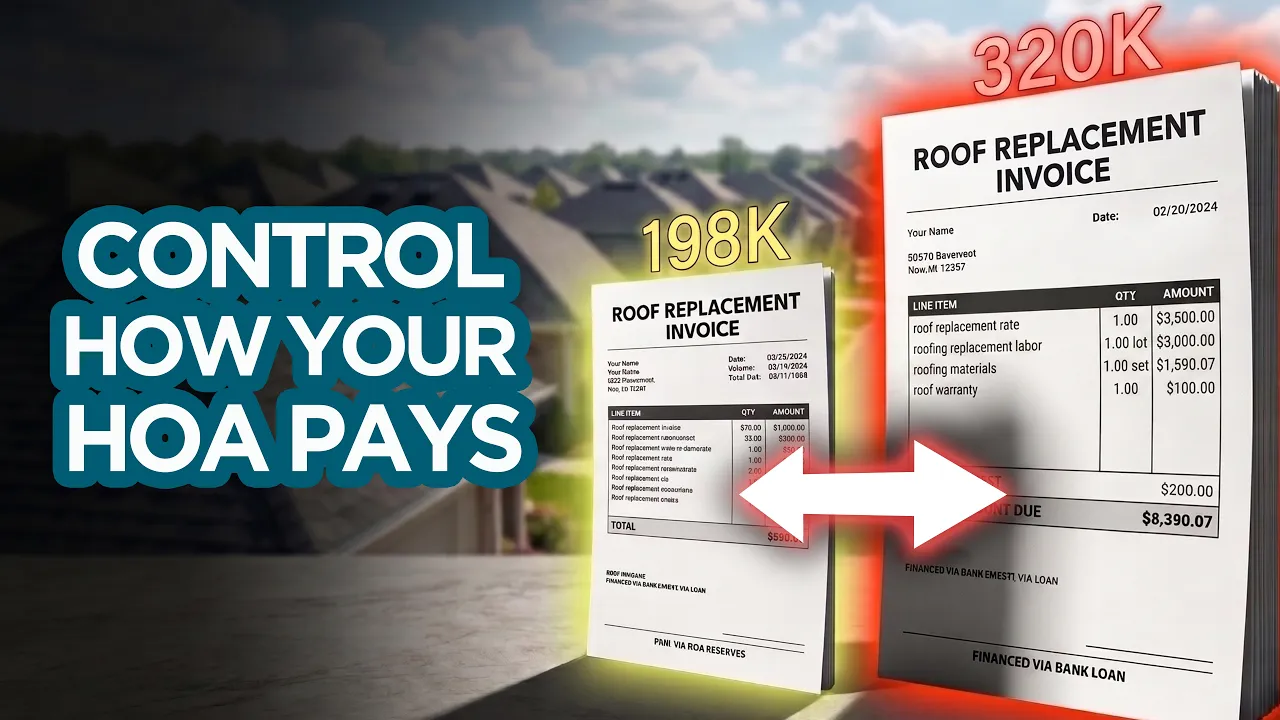
You have a $250,000 roof with a 15-year life, a seven-year loan at 7%, and 3% earnings on the money in your reserve account.
If you were putting aside the money properly over the course of 15 years and earning 3% interest, the net effect of what you’d be paying would be approximately $198,000.
If you didn’t do that and the roof failed and you needed the money today to replace it, it’s obviously $250,000. That’s exactly what it costs through a special assessment.
If that same $250,000 roof were funded through a loan, you’re then paying back the loan cost and interest over the next seven years. It’s going to cost approximately $320,000.
Just look at the difference between budgeting for it through the reserves at approximately $198,000 and funding it through a loan at approximately $320,000.
Another thing I’d like to touch on while we’re looking at this—and hopefully this is impactful—is that borrowing doesn’t just cost more money. It’s also a lot of extra work.
Even the special assessment option often comes with a lot of pain and chaos.
Many of you board members are dealing with this or have dealt with it. You need funds. You may not want to go to the bank, and you don’t have the money in the account. You’re passing an emergency special assessment for something.
That draws out almost every homeowner in a community. There’s a lot of anger and a lot of chaos surrounding that short-term notice to a community of members.
There’s a saying that the borrower is servant to the lender, and I think you get the picture. The bank has control over the terms of the loan.
When you need money, the bank dictates those terms—not only the interest rate, but the payback period and everything else.
What’s very ironic and interesting is that the very terms the bank imposes on you are often the same terms you should have imposed upon yourself without the interest.
Meaning, had you been properly planning for the five or 10 years beforehand, it’s approximately the same money the bank is now going to require from you when you look at the monthly payments.
If you do it properly from the beginning, you don’t have to give the bank that control or pay the extra interest.
Let’s pause for a quick moment. We’d love to hear from our audience, and be honest. We’re not talking about small projects here.
If you look back at your major projects—maybe it’s an elevator, roof, asphalt parking lot, roadways, or something like that—how have you historically funded those projects?
Were you saving ahead for those projects? Were you paying for them when they failed through a special assessment? Or were you borrowing from a bank?
We’d love to hear the results.
Jen:
All right, everyone, go ahead and put your results in the Q&A. The chat should be disabled, so you can’t put it in there.
All right. Lots and lots of ones. Some twos. No threes so far. Oh, we’ve got all of the above.
I see a few people are raising their hands. Please type your questions into the Q&A box.
Yeah, lots and lots of ones here, Brian.
Brian Weaver:
That’s awesome. That actually speaks volumes. We had, I think, about 60% returning audience members. That means they’re listening to the webinars and paying attention.
Robert Nordlund:
I like that.
Brian Weaver:
There you go. We’re making the world a better place.
That’s great. I will tell you, thank you to the board members who are doing this prudently. You guys are doing a great job.
I say this to many boards: you’re put in a tough position. It’s a volunteer position. You get beat up very often by many people from different directions. But as leaders, you’re tasked with making the tough decisions, and it’s great to hear that a lot of you on this call are making those tough decisions and funding properly in advance.
I will say, it’s tough in the beginning to get on track. But once you’re on track, it’s actually the easier decision rather than waiting and having to deal with emergency special assessments.
So congratulations to those who are doing this right, and again, thank you to our diligent board members here.
Whose problem is it at the end of the day when you find out about a looming problem?
Very often, the issue is faced by newer board members, but whether you’re a new or existing board member, you’re generally the first to know what’s really going on in the association.
The technical answer is that when you’re aware of what’s going on, it does become your problem to solve.
You were voted into that position. You are a leader of that organization. It is your job to roll up your sleeves, solve the problem, and navigate your way through it.
Again, that’s why you’re in that leadership role.
New board members are often recruited by fellow board members, or they have a particular issue where they want to help the community. Very often, they join the board and, after a few meetings, understand the state of their reserves and what kind of projects they’re facing. Sometimes they feel like they’ve stepped into a hornet’s nest.
If that’s you on this call, take courage.
Sometimes it is a hornet’s nest, but the community needs you to stand strong, make decisions, and stand behind those decisions.
Again, it’s not fair, but if no one’s leading the ship, it’s just going to spiral out of control.
Once you know about the problem, begin putting together a plan to get through that storm and get out of that particular problem.
It’s a simple concept, but you’re on the board, and the ideal time to talk about a particular project might seem like six months from now. Whatever you have in mind, just understand that the roof, siding, and pavement do not stop deteriorating.
Very often, once common elements become exposed—think of your roof, siding, or even asphalt with large cracks that aren’t being dealt with, especially in cold-weather climates—those components begin to deteriorate exponentially beneath what you can see.
The longer you wait, it’s not simply that the project gets pushed off a little bit. The problems escalate.
The underlying surface beneath the asphalt can become severely damaged and very expensive to repair. The same thing happens with roofs, sheathing, and siding.
When projects are due, it’s best to handle those projects.