



At a Glance
Whether a repair is a Reserve expense or an Operating expense comes down to a four-step check: does it appear on the Reserve Component List, does it pass the National Reserve Study Standards’ three-part test even if it isn’t listed yet, does it extend the component’s Remaining Useful Life, and how frequently does the cost recur. Getting this right keeps the Reserve Fund from being drained by routine maintenance and keeps the Operating Budget from absorbing legitimate Reserve projects. Association Reserves has helped boards and managers apply this decision process consistently across more than 100,000 Reserve Studies since 1986.
Accounting for expenditures is an important decision point for managers and board members. So, is it an Operating expense or a Reserve expense to repair a sprinkler, light fixture, lobby chair, or roof?
By going through these decision points in the correct order, you can keep your Reserve Fund from being depleted by unnecessary expenses, or keep your Operating Budget from being impacted by legitimate Reserve expenses.
Step 1: Refer to your Reserve Study
Every Reserve Study prepared in accordance with the National Reserve Study Standard will include a Component List of projects that meet all three elements of the following three-part test:
1. The association has the obligation to maintain or replace the existing element. 2. The need and schedule for this project can be reasonably anticipated. 3. The total cost for the project is material to the association, can be reasonably estimated, and includes all direct and related costs.
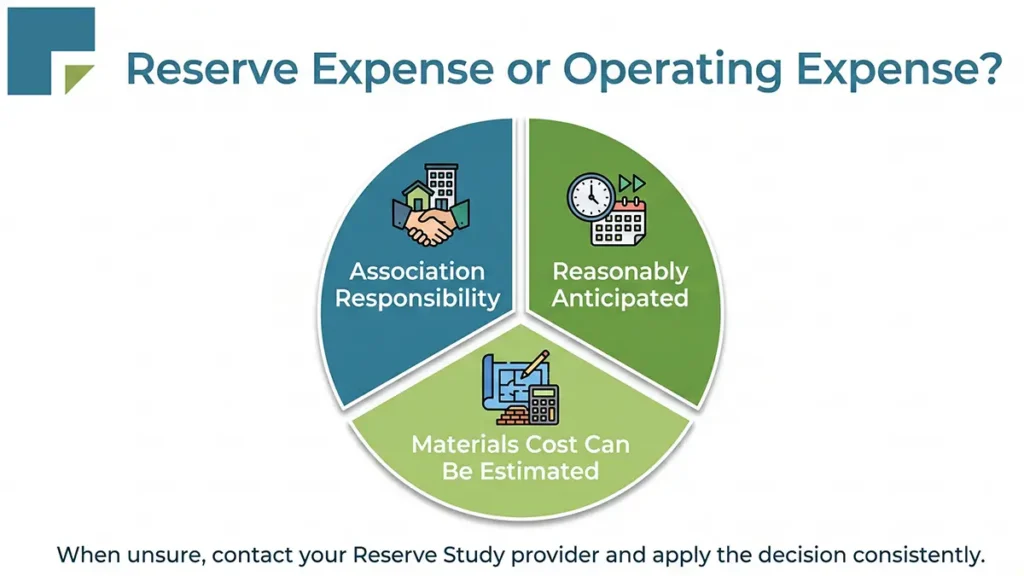
See if your Reserve Study professional has already anticipated and documented that project in the Component List. If so, it is a Reserve expense. What if a project is not listed in the Reserve Study?
Step 2: Amend the Component List
The repair or replacement project is a Reserve Component if it passes the three-part test above, even if it doesn’t appear on the Component List. National Reserve Study Standards are the higher authority, not the Reserve Study itself.
If you believe you have a project that passes the three-part test, contact your Reserve Study provider. Request that they add the project to the Component List the next time the Reserve Study is updated. Meanwhile, spend money from the Reserve account for this project, and prepare for higher Reserve funding requirements.
Related: Which Components Belong in the Reserve Study?
Step 3: Does the Work Extend the Component’s Remaining Useful Life?

If maintenance, such as a significant repair to a roof, fence, or section of carpet, is needed and isn’t listed as a Reserve Component, determining whether the work should be paid from the Operating or Reserve account can be difficult. The critical question is: does doing the work extend the component’s Remaining Useful Life (RUL)? If yes, the project should be paid from Reserves, and your Reserve Study provider should be notified to make the appropriate life-extension change in the next update.
If the expense will make a portion of the component “new again,” such as a new roof on one building that needed to be totally replaced, this is a special case of the project extending the component’s Remaining Useful Life. In this case, spend the funds from Reserves, and notify your Reserve Study professional so the component can be split into separate line items (an “old” part and a “new” part) in the next update.
Step 4: Consider the Frequency of the Project

Finally, how frequently does the cost occur? An association’s Operating expenses typically occur, or recur, on a daily, weekly, or monthly basis. Unbudgeted expenses that arise periodically throughout the year, like replacing light bulbs or sprinkler valves, local concrete sidewalk repairs, or random plumbing repairs, are Operating Budget expenses if they’re individually under the Reserve threshold amount and aren’t significant enough to extend the component’s Remaining Useful Life.
However, if the costs are aggregated into a single event, such as buying a case of replacement light bulbs every other year, grinding and repairing several sidewalk areas every year, once-a-year gutter cleaning, or proactively re-piping a section of the building each year, it can be funded through Reserves if the cost is above the Reserve threshold. If the project doesn’t currently appear in the Reserve Component List, contact your Reserve Study provider so it can be added at the next update.
Why Do Experience and Consistency Matter Here?
Budget issues are not always black and white. The importance of experience and consistency cannot be overstated. The three-part test will help you improve the consistency with which invoices are applied to Operating or Reserves. Keeping the organization’s finances organized is one way to point your association toward a safe, successful, and improved future.
Key Takeaways
Check the Reserve Component List first. If the project’s already listed, it’s a Reserve expense. If it’s not listed but passes the three-part test, it’s still a Reserve expense; get it added to the Component List at the next update. If a repair extends a component’s Remaining Useful Life, it’s a Reserve expense, even if it wasn’t previously on the list. Small, recurring costs under the Reserve threshold are Operating expenses; the same costs aggregated into a single significant event can be Reserve expenses. Consistency in applying this test matters as much as the test itself for keeping both budgets accurate over time.
Talk to a Reserve Specialist
Association Reserves has helped boards and managers apply this Reserve-vs-Operating decision process consistently through more than 100,000 Reserve Studies nationwide since 1986. Find your Reserve Specialist if you have a project you’re not sure how to classify.
Frequently Asked Questions
How do you decide if an expense is a Reserve expense or an Operating expense?
Check whether the project is on the Reserve Component List, whether it passes the National Reserve Study Standards’ three-part test, whether it extends the component’s Remaining Useful Life, and how frequently the cost occurs.
What is the three-part test for Reserve components?
A component qualifies for Reserve funding if the association has the obligation to maintain or replace it, the need and schedule for the project can be reasonably anticipated, and the total cost is material to the association, can be reasonably estimated, and includes all direct and related costs.
Does extending a component’s Remaining Useful Life make a repair a Reserve expense?
Yes. If a repair extends how much longer a component will last, it should be paid from Reserves, even if the project wasn’t previously listed on the Component List.
Are small recurring repairs Reserve or Operating expenses?
Small, individually low-cost recurring repairs, like replacing light bulbs or sprinkler valves, are typically Operating expenses. The same type of cost aggregated into one larger, significant event can qualify as a Reserve expense.
What happens if a project isn’t on the Reserve Component List?
If it passes the three-part test, it’s still a Reserve expense. Contact your Reserve Study provider to have it added to the Component List at the next update.