


What does it mean for an HOA to be underfunded?
An HOA is considered underfunded in this analysis when its Reserve Fund has less cash than the level associated with a strong Percent Funded position. Association Reserves classifies 0–30% Funded as weak, 30–70% as fair, and 70% or higher as strong.
How Common Are Underfunded HOA Reserve Funds?
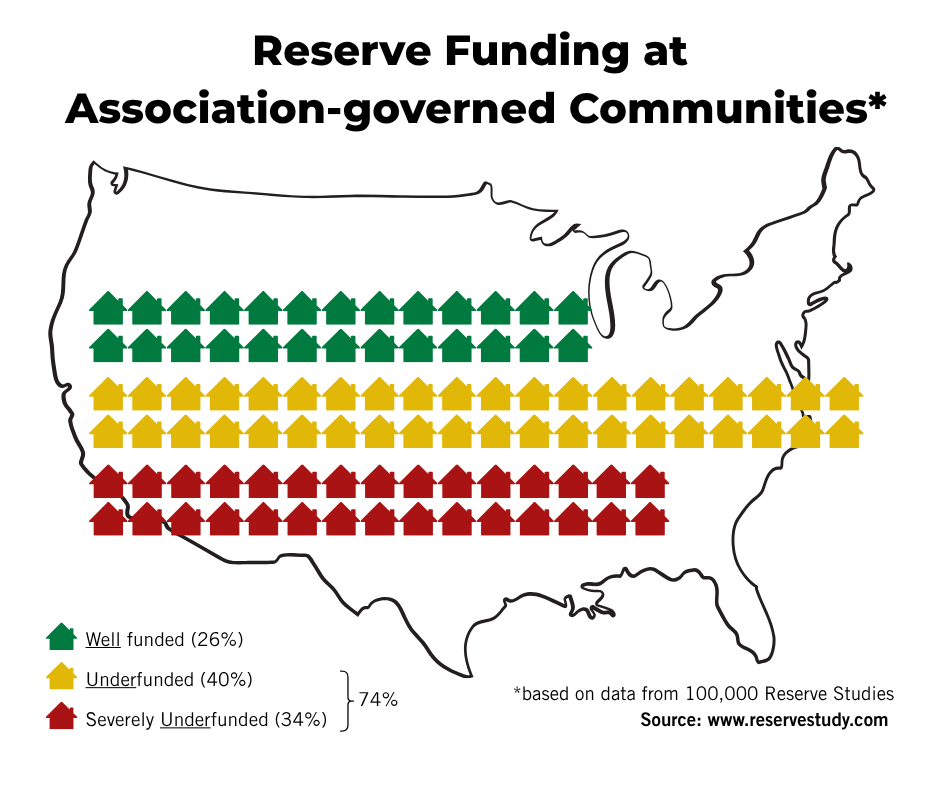
Across the US, most communities face the hard truth of underfunded reserves. This statement is made based on an analysis of over 100,000 Reserve Studies prepared by Association Reserves in the 39-year time period from 1986 -2025, using terminology and calculation protocols established in CAI’s National Reserve Study Standards. The results, which were based on a measure of Reserve Fund strength called “Percent Funded”, determined that 74% of Associations within our entire reserve study data were less than 70% Funded.
Less than 70% funded is the point where an Association becomes ‘underfunded’
— meaning it may not have enough saved in Reserves to cover expected projects.
When an association’s Reserve Fund is less than 70% Funded, it means the cash available for Reserve projects is less than 70% of the monetary value of deterioration those funds were designed to be used for. Put simply, if your community is 30% funded, you only have 30 cents saved for every dollar of wear & tear the property has accumulated. This puts the association at risk of not having sufficient cash to perform scheduled (and usually necessary) reserve projects on a timely basis.
You can measure how much common areas have worn out — in dollars — using something called the Fully Funded Balance (FFB). FFB is the computed value of the deterioration of all the Association’s reserve projects. This figure is determined by multiplying the “fractional age” (Age/Useful Life) of each component by its current estimated repair or replacement cost, then summing them all together.
How Is HOA Percent Funded Calculated?
% Funded = Reserve Fund Balance/Fully Funded Balance (FFB)
Let’s consider a simple example:
Imagine an Association on the first day of their fiscal year, with $40,000 in Reserves, only two common area maintenance responsibilities:
- Roof: replaced 7 years ago, Useful Life of 20-years, current estimated cost $200,000
- Painting: painted 3 years ago, Useful Life of 5 years, current estimated cost $50,000
| Component | Age (years) | Useful Life (years) | Cost | FFB Computation | Fully Funded Balance |
| Roof | 7 | 20 | $200,000 | 7/20 x $200,000 | $70,000 |
| Painting | 3 | 5 | $50,000 | 3/5 x $50,000 | $30,000 |
| Total FFB: | $100,000 |
So, the Fully Funded Balance is currently $100,000.
$100,000 represents the monetary value of the physical deterioration that has occurred since the roof was last replaced and since the building was last repainted. This also represents the ideal target for how much the Association should have set aside in Reserves to completely offset this deterioration.
Now let’s do the Percent Funded calculation:
Percent Funded= Reserve Fund Balance ($40,000)/Fully Funded balance ($100,000) = 40%
A reserve balance that is equal to the Fully Funded Balance is 100% Funded.
What Does a Low Percent Funded Mean for an HOA?
At first glance, $40,000 in the bank might sound healthy. But compared to the growing obligation of $100,000 worth of physical deterioration, this means the Association has only 40% of the funds on hand that it should have at this time.

This fictional association is “behind” in collecting the funds from the Owners that will prepare the association to complete the eventual roof replacement and repainting project in a timely manner. Without change, that shortfall can mean special assessments, loans, or project delays — all of which cost homeowners more in the long run and threaten property values.
Percent Funded measures reserve fund strength at a point in time. It does not, by itself, guarantee whether a special assessment will or will not occur, but lower Percent Funded levels have historically been associated with higher costs and risk.
Are HOA Reserve Funds Becoming More Underfunded?
When we look at the data through the years, we note some troubling trends:
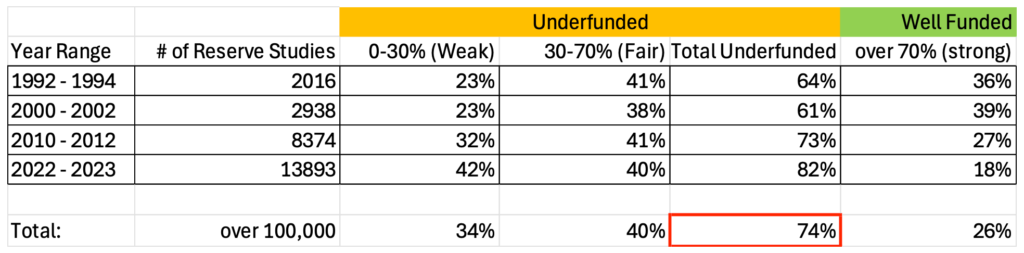
This trend reflects Association Reserves client data and should not be interpreted as a statistically representative census of every association-governed community in the United States.
For many years, the total number of underfunded associations ranged from 61 to 73%. But in our most recent two-year study (during the high inflation years and COVID-19), we found that Associations were significantly falling behind in their Reserve Fund strength, with 82% of our clients falling into the “underfunded” category. That’s the highest underfunding rate we’ve ever recorded. We attribute this to higher costs (driven by a high rate of inflation in those years), and the higher level of scrutiny Reserve Study professionals placed on Client properties in the years immediately following the 2021 tragic collapse of Champlain Towers South.
While many states do not legally require Associations to fund reserves to a specified level, best practice is to fund reserves at a rate that keeps close pace with ongoing common area deterioration. This approach shares the true cost of upkeep fairly among all homeowners and yields a strong enough Reserve Fund balance to sustain the common areas and protect property values.
Averaging the results of more than 100,000 Reserve Studies Association Reserves prepared for clients in all 50 states, 74% of associations have less financial margin to absorb project timing or cost surprises, and face greater risk of needing special assessments or loans to perform their major repair or replacement projects in a timely manner.
What Should HOA Boards, Owners & Buyers Do About Underfunded Reserves?
Most Association-governed communities across the nation are indeed in a financially challenged state and their Reserve Funding needs to increase dramatically to catch up with the true cost of home ownership that has largely been ignored.
- Board members need to take bold, proactive steps — courageously raising assessments to turn the tide on underfunding
- Current owners should understand that maintaining real estate is costly — and support board decisions that protect long-term property values
- Prospective buyers (anyone considering buying property at an HOA) should always ask about the HOA’s Reserve Fund strength — it’s one of the simple ways to avoid surprise special assessments after moving in.
Well-funded Reserves protect everyone — homeowners, buyers, and Board members alike. When Boards adopt sound funding practices, they minimize financial strain, preserve property values, and ensure that common areas are maintained responsibly and consistently. A well-managed Reserve Fund reflects prudent governance and a shared commitment to sustaining the community’s long-term health and stability. See related article: Relationship between Percent Funded and Special Assessment Risk
Related Articles:
Relationship between Percent Funded and Special Assessment Risk